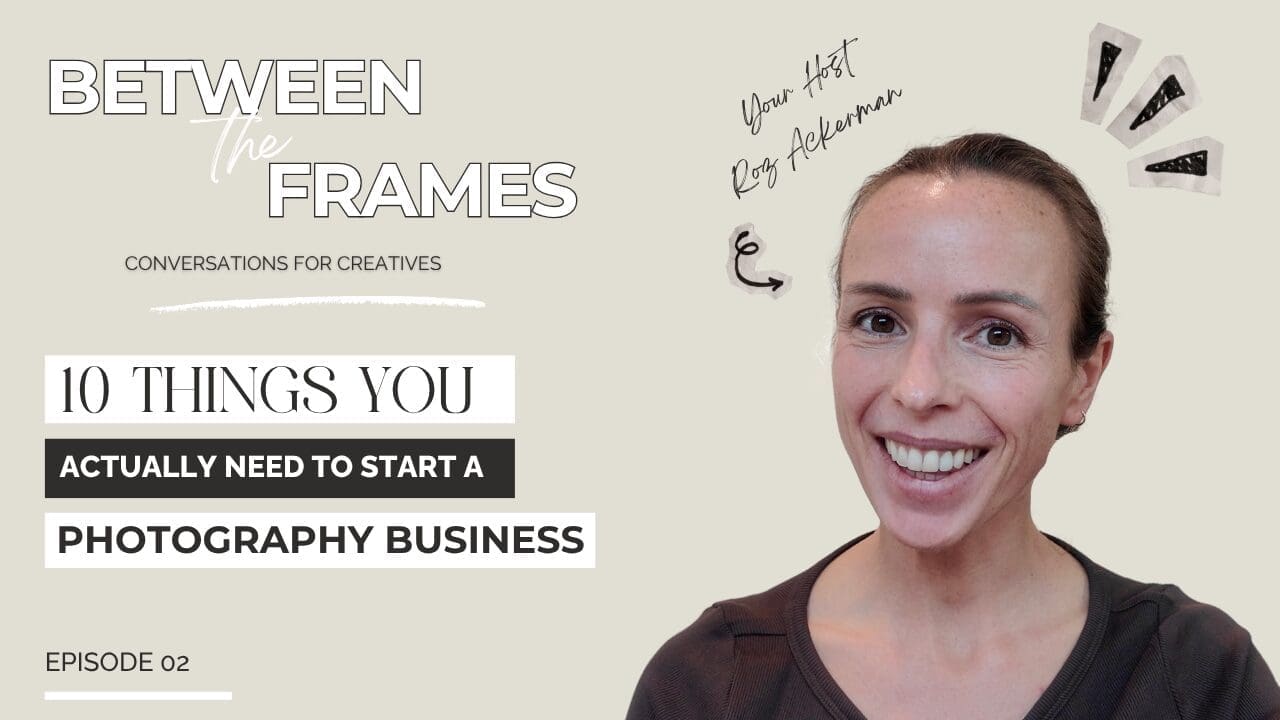
EPISODE SUMMARY
If you’re thinking about how to start a photography business — whether you’re launching in 2026 or planning ahead for 2027 — this episode is your starting point.
I break down the 10 things you actually need to get off the ground, drawn from my own experience of building a business while navigating early motherhood. No fluff, no overwhelm — just an honest, practical framework from someone who’s been there.
IN THIS EPISODE
00:00 Welcome & Intro
00:46 Why 2026 is a great time to start
02:57 Personal update: daughter’s dance recital was this weekend
07:18 #1: Headshots — why you are the brand and why hiding behind a logo is costing you connection
09:42 #2: Gear — what you actually need, focal lengths for family photography, and why your kit lens probably isn’t cutting it
14:42 #3: Posing — free resources, the Unscripted Posing app, and why even candid photographers need to ask about shot lists
18:39 #4: Making connections — building your network in the community, vendor relationships, and why other photographers are not your competition
25:06 #5: Getting a mentor and building a mood board — finding your style before someone else’s preferences define it for you
30:16 #6: Portfolio — how many shoots you need before you launch, and how to get them
32:02 #7: Website — platform options, what your site needs at minimum, and an honest note about blog content and platform migration
37:51 #8: Social media — choosing your platforms, showing up consistently, and why a content calendar is non-negotiable
39:58 #9: Run Ads — why organic reach alone isn’t enough in 2026 and how to start small
41:54 #10: Pricing — why undervaluing yourself leads to burnout, and how to figure out what to charge
46:01 Roz’s origin story
52:54 Outro
OUTROLINKS & RESOURCES MENTIONED
*Unscripted Posing App — a great tool for posing guidance, especially when you’re starting out.
*Denver Photo Collective — an example of what a local photo community can look like (owner Becky Durigan) save $50 on your first month’s membership with code ROZ50
*Pricing / Cost of Doing Business Calculator — use this before you set your rates.
GEAR
Camera – Canon R6
Lens – Canon RF 24-70mm
Links in my Amazon Store
PLATFORMS
* Honeybook – save 30% off your subscription
* Showit – get a free month of Showit
* Pixieset galleries – save $20 with pixieset galleries or any of their apps.
PEOPLE
* Mentorship – Hello Miss Lovely / Autumn Beury → / hello_miss_lovely
* Posing – Kierstin Jones → / kierstinjones
Cassidy Lynne → / cassidylynne
CONNECT WITH ROZ ACKERMAN
- Instagram: / rozackermanphoto
- Website: https://rozackerman.com
- Submit a question or topic: roz@rozackermanphotography.com
AFFILIATE DISCLOSURE
Some of the links in these show notes may be affiliate links, which means I may earn a small commission if you make a purchase through them — at no extra cost to you. I only ever recommend tools and resources I genuinely believe in. Thank you for supporting the show. 🤍
Episode Transcript
[00:00] INTRODUCTION
Welcome to another episode of Between the Frames. I’m your host, Roz Ackerman. Thank you for being here. Today we are going to be talking about 10 things you actually need to start a photography business in 2026.
I know we’re already pretty much halfway through the year — it’s almost June at the time of recording. You might be thinking this is coming a little late, but just because we’re halfway through the year doesn’t mean you’re not still thinking about starting a business. Maybe these tips will be useful if you’re planning ahead for 2027.
Before I dive in, let me just say: I think now in 2026 there has never been a better time to start a photography business. The tools available to us are incredible. I started setting up my business in 2023 and it was so much harder back then. Everything was slower, AI hadn’t really taken off yet. So trust me — you have so much more going for you right now.
I also get that there’s a sense of overwhelm, because there are so many different directions you can go — which platform is better, which CRM to use, all of those things. That’s exactly what this episode is here to help with.
[02:57] PERSONAL UPDATE — MY DAUGHTER’S DANCE RECITAL
I’ll be honest — I’m feeling a little bit of a hot mess today. I’m overtired and running on too much caffeine. This is just my mom energy in 2026, and I’m sure a lot of you can relate.
Yesterday was my daughter’s dance recital — her third year. Her first recital was back in 2024 when she was just a little bit older than three, which was incredible. Seeing how grown up she is now just blows my mind and honestly makes me feel very emotional.
It’s been a whole thing since Friday — rehearsal ran an hour late, my son is going through the terrible twos, and I ended up staying up way too late last night editing the photos I took of her. My husband looked at me sitting at the kitchen counter and said, “This is like your toxic trait. You come home from taking pictures and you immediately have to upload them, cull them, start editing. Is this just you or is this all photographers?” I told him I’m pretty sure it’s all photographers — but let me know if it’s different for you.
I find it really hard to come home from a session and not want to immediately dive in and see how the photos look. There’s nothing worse than that sinking feeling when you start looking at your raws and realise you’re off-centre. But it’s also that excitement of seeing the work come together. Anyway — that’s why I’m a little tired today, and my daughter also has a synchronised swimming recital this afternoon, so here we are.
[07:15] THE 10-ITEM CHECKLIST — A QUICK NOTE BEFORE WE START
Just a quick note before diving in: these 10 things are not listed in strict order of importance. Think of this as a checklist, not a ladder. They don’t all need to be perfectly executed — if you can get 70 to 80% done, that’s great. Perfection is not what we’re striving for. You can always build from where you’re at. Let’s just get the ball rolling.
[07:18] #1 — HEADSHOTS
First on my list is headshots. Photographers are not just putting out pretty pictures anymore — that is not what people want. It’s 2026. People are craving connection. They want to see the human behind everything. They want to know they’re not dealing with AI.
You are a personal brand. Do not forget that. You need to show your face on your website, on your social media, everywhere. People are only going to book you if they know who you are and feel connected to you. Think about it — you are photographing them at some of the most important stages of their lives. People need to know they can trust you, and that starts with seeing your face.
Ideally, get some headshots with your camera in hand, or with your camera somewhere visible in the frame. Make sure your face is clearly on your profile photos across Instagram, Facebook, and your website. You absolutely need an about me section on your website, and without photos of yourself, that’s just not going to work.
If you’re not sure who to get to take your headshots, you can set up a tripod and do self-portraits, or grab a fellow photographer friend and do a headshot swap. I do this all the time and we always have so much fun with it.
[09:42] #2 — GEAR
You can’t really start shooting if you don’t have any gear. Maybe you used to be a hobbyist but don’t have a great camera anymore — I kind of feel like that’s where I started. I had a really old Canon Digital Rebel XTi with a 50mm prime lens, f/1.8. It was fine to get started, honestly.
If you’re not sure what camera you want, I really recommend finding a local store where you can rent equipment and try a few different brands first. I went straight back to Canon because that’s what I’d used before, and I do love my Canon R6 — but I’ll admit I kind of wish I’d tried Sony first. Everything I see about them suggests they’re very user-friendly and super lightweight, which matters a lot when you’re shooting for hours.
For lenses: don’t just stick with the kit lens that came with your camera. It’s usually not great for portrait photography. My personal recommendation if you’re starting out is to get one good zoom lens. I shoot primarily families, couples, and children, and my 24–70mm has been on my camera almost every single shoot. It’s still perfect. If you’re shooting weddings, think about longer focal lengths too.
Don’t let gear be the reason you wait to start. Rent what you can, look at secondhand gear in local stores — you do not need to pay full price for incredible equipment.
[14:42] #3 — POSING
Posing is something I kind of took for granted when I first started. I thought I’d just show up with some Pinterest poses in mind and put people in them. I quickly realised that’s really hard to pull off, especially with families — and it didn’t suit the lifestyle, candid style I was trying to create.
It’s good to have a collection of poses you like the look of, but more important than that is understanding how to prompt people so they naturally fall into those positions. I actually coach fitness classes, so I’m used to cueing people — and I still found this hard with photography. There’s real skill in it.
You can find so much education for free on YouTube and Instagram. There are so many great photographers sharing posing tips on their channels. I’ll drop a couple of recommendations in the show notes. There’s also the Unscripted Posing app, which has a whole gallery directory you can browse — it’s a bit like Pinterest but specifically for posing, and it’s really helpful.
If you’re shooting weddings or extended family sessions, always have a dialogue with your clients beforehand. In my client questionnaire I always ask: are there any specific photos you absolutely must have? Even if you’re a lifestyle or documentary-style photographer like me, it’s important to know what your client is hoping you’ll capture. Understanding their expectations upfront means you can relax into the session knowing you’ve got them covered.
And always spend the first five minutes of a session just making people feel comfortable — even if those early images are throwaway shots. Get them moving, playing, laughing together. Once that natural energy is flowing, the rest of the session feels easy.
[18:39] #4 — MAKE CONNECTIONS
When you’re starting a business, you are going to need a network. Offer some discounted shoots within your community — but be intentional about it. Think about who your ideal client is and go where they already are.
For example, I primarily work with families, so I approached my kids’ preschool. I helped them with their website photography, and in return they credited me when they launched, let me know to families that I was a photographer, supported my mini session announcements, and welcomed me in to do school portraits. I’m right there in my community, speaking directly to my audience.
Target businesses that make sense for your ideal client. And don’t be afraid to go to networking events — I recently found a motherhood entrepreneur group through Eventbrite and I’m kicking myself that I haven’t done this sooner. You cannot just sit and wait for people to come to you.
If you’re working in wedding photography, connect with hair and makeup artists, florists, and venues. Try to get on their vendor lists. I connected with a florist and some event photographers this year and I’m really excited about those collaborations.
And then — join a photo collective if you can. I’m currently a member of Denver Photo Collective, run by Becky Durgan, and it has been amazing. We have access to the studio, headshot days, events, and most importantly a whole community of photographers. When someone in the group gets offered a job they can’t take, they drop it in the group and refer it out. I’ve gotten referrals that way that I would never have found otherwise.
Community over competition. Other photographers are not your enemies — they can be some of your best referrals. Being part of a creative community also just helps normalise everything you’re going through. Photography can feel really solitary, and it feels great to be part of a team.
[25:06] #5 — GET A MENTOR OR JOIN A COACHING PROGRAM & BUILD A MOOD BOARD
This is something I really wish I hadn’t waited so long to do. I struggled for a couple of years figuring out my style, my direction, who my clients were. A mentor can hold you accountable and help you develop your brand so much faster than going it alone.
If you’re not quite ready for a mentor, at least start building a mood board. Pin everything you see in photography that you love — colour palettes, locations, editing styles, photography styles. Then start consolidating and removing things until a clear aesthetic emerges.
I think I also made the mistake early on of going into sessions thinking about what my clients wanted rather than what I wanted to create. I’m a people pleaser — I can’t help it. And honestly, I was assuming a lot. I had a really hard time thinking of myself as an artist.
So let’s just sit with that for a second. You are a photographer. You are creating art. You are an artist. You have to be true to yourself. If you’re not creating imagery that you love and a style that feels authentic to you, you’re going to quickly stop enjoying the work. You need to feel passionate about what you’re making — and when you do, you will very quickly build a consistent, desirable portfolio that stands out to your ideal clients.
I worked with a mentor last year — Autumn Burry from Hello Miss Lovely — and it was genuinely a game changer. I had actually intended to go on a retreat she was hosting, but she ended up having to cancel and offered me a business mentorship package instead. I didn’t hesitate for long. I cannot recommend it enough. I’m just sad I waited so long.
[30:16] #6 — PORTFOLIO
You cannot book clients if you don’t have any images. Before you launch anything publicly, you need to do some shoots. I’d say a minimum of five sessions so you have some variety. Use your friends, use your family, put out a model call — there are photographer groups on Facebook for most locations where you can do exactly that.
Be intentional about what you’re shooting. Think about who your ideal client is and shoot toward that. If you want to photograph families, shoot families. If you want wedding or elopement content, look for styled shoots — there are plenty out there where you can get that kind of imagery for your portfolio.
You will probably need to shoot for free for those initial five sessions. That’s okay. Think of it as an investment in the portfolio that’s going to book you real paying clients.
[32:02] #7 — WEBSITE
You need a website. At minimum it needs: a homepage, a portfolio page, a contact form, and some kind of investment or pricing page. Four pages. That’s it to start.
I began with Pixieset because it had everything under one roof — website, galleries with a built-in store, bookings, a blog, and basic CRM. For where I was at, it made complete sense. The built-in store matters more than people realise — it’s an opportunity to keep making money after the session is done if clients want to order prints or artwork.
Since then I’ve moved my CRM to HoneyBook, which has incredible automations and just looks so professional. And I moved my website to Showit, which is beautiful for showcasing work as an artist — so much more flexibility in layout and animation than Pixieset offered me.
One thing I will say: when I moved from Pixieset to Showit, I was not able to easily transfer my blog content. Showit can migrate content from Squarespace and Wix, but Pixieset’s blog is built in, so there’s no automatic migration — it all had to be done manually. That’s a real consideration if you’re building up blog content for SEO. Just something to be aware of before you commit.
Squarespace is another great starting point if Showit feels too complicated upfront. Pick a platform that helps you build something clean and functional. A simple website that works beats a perfect website that doesn’t exist yet.
[37:51] #8 — SOCIAL MEDIA
In 2026 you absolutely need to be on social media — but you do not need to be on every platform. Pick two or three and use them well. The ones you’re on, use intentionally and consistently.
Set yourself up with a schedule. A content calendar is a great idea — something that holds you accountable and takes away the daily “what do I post?” spiral. There are scheduling tools like Planoly and Tailwind that can help you plan and batch your content. If you’re big on Pinterest, Tailwind is specifically designed for that.
Treat social media like a business task because it is one. You have access to a free tool that can put you directly in front of your ideal audience. Use it.
I have a whole episode coming up specifically about social media, so stay tuned for that.
[39:58] #9 — RUN ADS
Organic content alone is a slow game in 2026 — and getting slower. Ads don’t have to be expensive or complicated to start. I recommend Google Ads and Meta Ads (Facebook and Instagram). I had really good success with Google Ads, and honestly a couple of years ago I wouldn’t have known how to set them up — I would have had to hire someone on Fiverr. But now AI can literally walk you through it step by step.
Yes, it takes some time to learn. But it pays off. I got plenty of new inquiries and bookings from running Google Ads. Don’t get too fixated on the cost — if you spend $500 and get three bookings, that’s worth it. Start small, learn what works, and build from there.
[41:54] #10 — PRICING
Do not undervalue yourself — especially once you’re ready to actually charge. Underpricing doesn’t just hurt your income. It fills your calendar with the wrong clients and leads to burnout.
At minimum, put a starting from figure on your website so clients know what to expect. Transparency saves everyone time.
And please, use a pricing calculator or cost of doing business calculator before you set your rates — I’ve linked to one in the show notes. Think about everything that goes into a session: the planning beforehand, the session itself, uploading, culling, editing, delivering the gallery, communicating with your client, and the cost of all your gear and tools. It is an expensive business to run. When you actually calculate it out, you’re probably going to surprise yourself.
I know that for the first couple of years, you might feel like you’re grinding and slightly undervalued. That’s kind of normal. But don’t let it go on too long. Once your work is consistent and strong, have the confidence to raise your prices to match your value. You’ll have fewer sessions but earn more per session — and you’ll have more time. Which is what we all want.
[46:01] ROZ’S OWN STORY — WHERE I STARTED
Just to give you some context on where I started: I got into photography professionally by contracting with a wedding photography company. I was a second shooter at weddings for a summer. My daughter was one at the time, and we were also trying for another baby. I got pregnant at the end of that summer, and I quickly realised that pace wasn’t going to be sustainable with two kids.
So at the end of that summer, I started building my own business slowly. I photographed friends and family to build my portfolio. I started a website in draft mode with placeholder images. During my son’s first year — 2023 — I wasn’t doing a lot of paid work, but I was building everything on the backend: pricing guides, wardrobe guides, style guides, HoneyBook automations. All the framework that would work for me once I did start booking shoots.
Then I joined a photo collective, started building my photography community, and things started to pick up. The moral of the story: you do not have to have everything perfect from day one. Do a little bit every day, chip away at the list, and build from where you are.
[52:54] CLOSING
Building a photography business is not easy — especially when you’re doing it alongside motherhood. But you have something worth sharing. A perspective, a style, a way of connecting with people that nobody else has. Do whatever it takes to stand out. Don’t let fear, embarrassment, ego, or fear of rejection stop you — those things are going to happen at some point anyway. You’re not a failure. You’re learning. You’re human.
Come back to your why regularly. Write it down if you need to. What do you want to achieve in five years? What does success look like to you — as a photographer, as a mother, as a person? Keep showing up for that.
You are unique. Your work has tremendous value. Please don’t give up.
If you found anything in this episode helpful, please leave a review — it genuinely helps the show grow and helps me understand what you need more of. Reviews are also what makes things like transcripts, chapters, and timestamps more accessible for you. It’ll take you less than a minute. And don’t forget to subscribe wherever you listen so you never miss an episode.
Talk soon. Bye!
Roz Ackerman is a Boulder and Denver lifestyle photographer specializing in family & couples photography across the Colorado Front Range.
Leave a Reply Cancel reply
Honest, heartfelt portrait and elopement photographer for modern women and the families they center. Serving Denver, Boulder, Arvada, Lafayette, Louisville, Superior, Westminster and the Colorado Front Range. Available worldwide to tell your story.
ROZ ACKERMAN


©2026 | ROZ ACKERMAN photography
©2026 | ROZ ACKERMAN photography