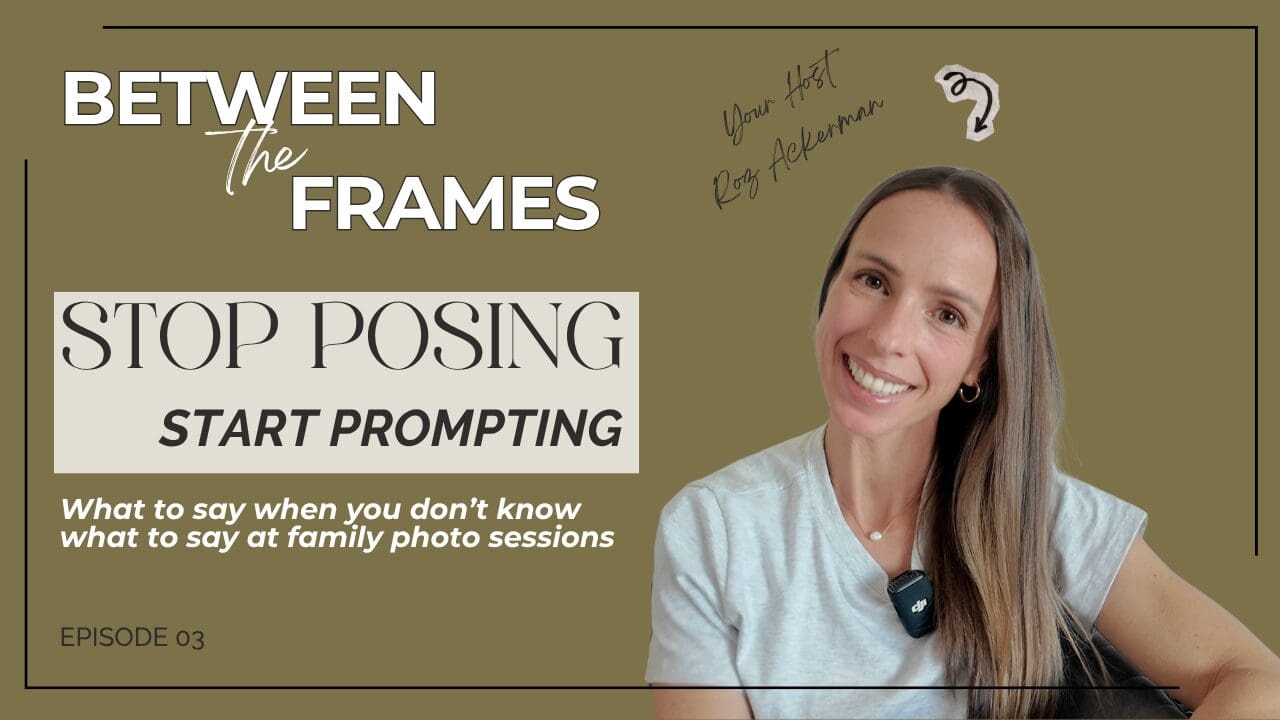
Prompting families – beyond posing in lifestyle photography
What to Say When You Don’t Know What to Say at Family Photo Sessions
Ever freeze up at a family session and wonder what to actually say to get real, genuine moments? In this episode, I break down the difference between posing and prompting — and why that shift changed everything about how I shoot. You’ll walk away with a practical toolkit of prompts organized by purpose: getting kids to cooperate, creating genuine connection, and what to do when something falls completely flat.
[00:01] Welcome + Episode Intro
[01:33] Mom Life Update
[05:15] Being New to This + Doing the Hard Thing
[05:59] Posing vs. Prompting — The Real Difference
The distinction that changes everything. Posing is about where you place people and how their bodies look. Prompting is about creating conditions where something real can develop. Roz shares how she started her photography career leaning into posing — and why it quickly became clear that prompting was a better fit for lifestyle and family work.
[09:05] What to Do After a Prompt Lands
One of the most overlooked skills: give the prompt, then stop talking. Roz talks about the importance of letting the moment unfold rather than over-directing, and why the in-between moments are usually the ones worth capturing.
[10:42] Episode Structure Overview
A quick roadmap — kid cooperation prompts, connection-based prompts, and what to do when things flop.
[11:57] Setting Expectations With Families Before You Start
Roz’s go-to move before any family session: a quick five-minute chat that normalizes the chaos. Kids crying, toddler meltdowns, someone needing a time-out — all of it is fine. The goal isn’t perfect smiles; it’s connection and real moments.
[14:38] Getting Kids to Trust You First
Before any prompt lands, you need the child. Roz talks about getting low, using the client questionnaire to gather talking points, and giving toddlers a sense of ownership and control — because toddlers who feel in control are toddlers who cooperate.
[18:04] Kid Cooperation Prompts
Six prompts specifically designed to get kids engaged, interacting, and (occasionally) forgetting there’s a camera:
[29:20] Connection-Based Prompts
The prompts that make parents tear up when they get their gallery back. Roz talks about reading the room before pulling these out — high energy is not the moment for a deeply emotional prompt.
[42:10] Reading the Room + When Prompts Flop
Prompts fall flat. It’s normal. Roz’s real-session story: trying the airplane prompt with a toddler who said no — and how she eventually got him flying by having mom do it first.
The lesson: timing matters more than the prompt itself. If you’re talking too much and the family isn’t buying in, move on. Come back to it later.
[46:38] How Roz Approaches the Flow of a Session
She tells families upfront: we’re going with the flow today. No rigid list, no working through poses in order. Just try something, see where it goes, stay in observation mode. That’s where the organic moments come from.
[47:53] Wrapping Up + What’s Coming Next
A tease for the next full episode: 30 poses organized by category and energy level — the complete session toolkit. Plus Roz’s reminder that all of this gets easier with practice. Work with friends, work with families you’re already comfortable with, and let the prompts become second nature.
CONNECT WITH ROZ ACKERMAN:
Instagram: @rozackermanphoto → / rozackermanphoto
Website: https://rozackermanphotography.com
Submit a question or topic: roz@rozackermanphotography.com
Roz Ackerman is a lifestyle family & couples photographer based near Denver, Colorado.
Episode Transcript
Welcome + Episode Intro
0:01 Hi guys, welcome to another episode of Between the Frames. I’m so happy to have you here — and really, this is now or never because I literally need to get on a client call in about 25 minutes. So I’m cutting it a little close, but I know this is going to be a shorter episode today.
0:18 Today we are talking about prompting versus posing. My kind of workshop title for this episode is “Stop Posing, Start Prompting” — and this is all about what to say when you don’t know what to say.
0:39 I know there’s a lot going through your head when you’re at a session. And if you are new to photography and just started your business, posing is probably still really challenging for you. I think this episode is going to help you really unwrap that when you start thinking more about prompting.
1:00 This episode did spin out of Episode 2, where I was talking about 10 things you actually need to start a photography business. One of those things I mentioned was posing — being comfortable with it — because obviously you have people in front of you at your session and you need to direct them or have them interact in a way that’s going to look good on camera. So we are going to dive into that shortly.
Mom Life Update
1:33 I do just want to talk a little bit about myself, if that’s okay. If you don’t really want to get to know me as a host, that is totally fine — I will add some timestamps into the show notes. But when I listen to podcasts, I do love a little bit of an intro from the host, so that’s something I’m trying to incorporate into my podcast as well.
1:59 Just a couple of quick personal things going on in my life right now. I’m a mom — I’m going to keep it very real in case you don’t know that about me already. I was born back in the 80s, so you can do the math on my age.
2:20 Today I am currently suffering from some allergies. I went on a walk yesterday, and this is really strange — I genuinely don’t think I’ve ever had allergies in my entire life. But since having kids, all these things are just changing in my body. My hair used to be dead straight and now it’s got this weird little crimpy curl to it. And apparently I also have allergies now.
2:48 I was on a walk yesterday and there were all these pretty white fluffy things flying through the air. I whipped my phone out — “Oh, let me try to get pictures, so pretty.” And then in the middle of the night, one of my eyes just completely started watering so badly that I was actually in pain. I had to get up, rinse it out, put a cold compress on it. It was terrible. So if you can see some bloodshot eyes, that is the reality of my life right now.
3:29 On top of that, I was also up in the night with my three-year-old. So I’m just in that era where life is hard. I’m tired all the time. There is literally no good time to start the work, to do the things. That’s actually why I got started with this podcast — because I realized there is never going to be a perfect time. I just need to start.
4:00 I have actually done my hair today. I took a shower. I washed my hair. I know — shocker. This is not typical. But it is my husband’s birthday today and we’re going out for dinner tonight, so I thought — you know what, I need to record a podcast, and since I also put these on YouTube and record them as video — why not get ahead of it, get myself looking good, and get on camera.
4:31 This is not the usual look. Usually I’m in sweats, my hair is in a messy bun, and I have no makeup on whatsoever. Today I’ve got a little bit of tinted moisturizer. I genuinely don’t like wearing a lot of makeup, but tinted moisturizer is so helpful for just making your skin look a little bit dewy. So yes, I am trying to embrace a slightly less disheveled look today. That’s where we’re going.
5:07 Two birthday parties this weekend on top of my husband’s birthday tonight, so there’s a lot of mom stuff going on.
Being New to This + Doing the Hard Thing
5:15 And as you can probably tell, I’m still pretty new to recording podcasts and doing all the podcast stuff. Right now I’m finding it incredibly time-consuming. So if you’re listening and you’ve had a podcast yourself or you have any tips, insights, or helpful feedback — feel free to let me know. I’m new here. I’m learning. I’m doing the hard thing. So go easy on me is basically what I’m saying.
5:49 All right, let’s dive in because I know you’re here for some helpful tips about photography, not just to listen to me rant about my mom life.
Posing vs. Prompting — The Real Difference
5:59 So first off, we’re going to talk about the difference between posing and prompting. When you’re thinking about posing, I like to think we’re really talking about where we’re placing people, what their bodies look like — and you’re being really intentional and deliberate with that. When we’re prompting, we’re giving people directions so that we can create a condition where something real develops from that.
6:42 I think I really started my photography business leaning into posing because I didn’t really understand prompting at that point. I would look at Pinterest, have an idea in my head, and think, “I’ve just got to position people in that way.” But that’s really hard when you’re working with families. I primarily shoot families and couples — a lot of families — and my style is definitely more lifestyle-driven. I quickly discovered that posing was kind of hard with families, because little kids don’t really like to follow directions. It’s not really the vibe I’m going for. It can look very forced and very stiff.
7:41 So if you are struggling right now with posing, prompting is going to be really helpful for you. When we’re prompting, we’re not necessarily thinking about how all these bodies look together. Instead, we’re thinking about their relationship and their connection with each other.
8:05 It’s also worth acknowledging that with prompting, we’re getting more real-life imagery. If you’re someone who is looking for more of a storytelling approach to your photography — which I love, and I think people are loving more too — it takes the pressure off and it also documents exactly how those people are in that moment. So when they look back on it, it truly feels more like a memory than a staged pose.
8:46 So we’re really just looking to guide our clients into natural interaction, to provide them with beautiful imagery that is less about being perfect.
What to Do After a Prompt Lands
9:05 Your prompts are not necessarily always going to generate exactly what you’re picturing in your mind’s eye, because everybody interprets directions in slightly different ways. I would encourage you to be ready with those prompts, deliver them, and then kind of sit back and watch — so you’re not talking to your clients the entire time.
9:38 It’s important to be their cheerleader, to tell them they look beautiful and everything. But what we’re really going for is helping your clients be so comfortable in front of the camera that they almost forget you’re there. If you’re constantly prompting, prompting, prompting, talking, talking, talking — I think that detracts from their experience and can become overwhelming for the client.
10:11 So when I provide a prompt, I let it land and see what unfolds. Be ready for that, because some people are so focused on capturing something very specific that they already see in their mind’s eye — but often those in-between moments are actually what you want to be capturing.
10:42 Here’s the structure for today’s episode: I’m going to talk about prompts for kids to encourage their cooperation, since I’m specifically thinking about family sessions today. Then we’ll talk about prompts that encourage connection. And then I’ll dive into how prompts can completely flop, why that might be happening, and how to think about adjusting your delivery or timing rather than just giving up on a prompt entirely.
Setting Expectations With Families Before You Start
11:57 I think with family sessions — whether you’re not currently a family photographer but want to get into that space, or you’re already a family photographer but finding yourself leaving sessions feeling a little lackluster — the first thing I’ll say is this: family sessions are very energetic. They require a lot from you as a person and they are going to feel chaotic. I actually tell my clients that it’s completely normal for the session to feel chaotic.
12:50 That’s actually a great way to prep your clients on expectations — and you don’t have to do it weeks in advance. You can do it five minutes before the session starts. Just have a quick chat. Remind them that it’s okay if the kids are crying, if someone needs a little time out. We’re trying to capture the connection and the moments. Nothing has to be picture perfect.
13:28 Yes, we will capture moments where everybody is looking and smiling at the camera — I still think it’s important to include a handful of those, maybe three to five opportunities — but the majority of the time, you actually want your clients to pretend you’re not there. Something I like to tell my clients is to pretend I’m filming. Pretend it’s like a movie. If you can stay in the moment and enjoy yourself, it’s going to come across wonderfully in the images — even if your toddler is having a little meltdown. If you’re holding them in close, you can’t even see it, and I can always move around to find angles where it doesn’t show.
14:34 So we’re not about getting perfect smiles. We’re about getting the kids to engage.
Getting Kids to Trust You First
14:38 The other thing I like to do at the beginning of a session is try to engage with the children. I send out a client questionnaire so I can get a little insider information about the kids — that way I have some talking points. And when you have toddlers, maybe age three and under, just be aware those kids can be really shy. I always try to get low, get to their level, and ask them questions based on the talking points their parents have shared with me.
15:43 For example, I had a session the other night where the main goal was to feature these poppies in a gorgeous meadow in front of the Flatirons. So I got down and said to the little boy, “Hey, did you know there are some red flowers in this field?” He already knew — and this kid was two and a half and incredibly well-spoken. It honestly blew my mind. I kept forgetting how old he was, because my son, who’s three, is a little peanut and has had a speech delay. So when I meet other kids his age whose speech is incredible, I’m genuinely amazed.
16:52 Anyway, this little boy immediately rose to the challenge. I just said, “Okay, we’re going to go look for those flowers. Can you help me find them? Can you lead the way?” And that was it. He was totally involved and wanted to be the leader. He was completely sold.
17:13 So: get low to your kids, have some talking points, give them an activity, and let them feel like they have some ownership of the session. Toddlers really hate to be told what to do. That’s just the truth. I also recently tried to take solo portraits of my son for his birthday and literally every prompt I used was followed by a “no.” So just be prepared for that. Sometimes it just takes a while for kids to warm up to you. Don’t be deflated. Just roll with the punches.
Kid Cooperation Prompts
17:59 Alright — here are some fun prompts for kids. This is not an exhaustive list; I’m going to do a separate episode that’s more specific to posing and I’ll weave in more prompts there too. But here’s a little taster.
18:27 “Does mommy have a booger on her face?” A great way to get a kiddo laughing and to get them to look at their parent. Yes, I know. And here’s the thing: you have to be prepared to be a bit silly and a bit cringey. Just own it. If you are being silly, the kids are going to like that. Your session will go better, I promise. That prompt will get a really genuine reaction — probably a big smile from the child, maybe a slightly embarrassed parent who also ends up playing along. It’s just a really great way to get a kid who’s not engaging with their parents at all to look back up at mom.
19:32 “I bet I can guess your favorite food… is it broccoli?” I love making suggestions to kids that I know are wrong. Kids between about two and five are always thinking about what’s right and what’s wrong. If you give them an opportunity to correct you — oh, they’re going to love you. Usually what you get is two things: a great big smile because it’s a silly suggestion, and then they’re going to want to correct you and tell you what their favorite food actually is. You’re immediately starting a conversation with the child, which is exactly what you want. (My daughter Madison is apparently an outlier — she’s really into broccoli for some reason.)
21:28 “Who has the loudest farts?” This one works well when you’re doing something like walking with the family — either across your frame or toward you. If you want them to interact with each other rather than randomly looking different directions or at the camera, ask everyone to look at the person who has the loudest farts. Maybe they all look at dad, or maybe they all look at the youngest kid. It usually gets everyone smiling at the same time. It also works really well if they’re all grouped together on a blanket on the ground.
23:10 “Where’s your favorite place to go with mom? With dad?” Those things are really memorable for children and it gets them out of feeling like they’re performing and into thinking mode. It probably works a little better with older kids, but younger ones will surprise you. I bet if you asked my son, he’d say the grocery store. My daughter would say Target. Kids just love stores.
24:47 “What is your mom the best at?” This is a fun one because you just never know where a kid’s brain is going to go. Maybe they’ll say mom’s the best at making sandwiches. Or bath time. Or jumping. Who knows. Make sure you’re not just focused on the child who’s answering — look at how the parents are listening, look at their faces while the child is pausing to think. The anticipation, the reaction — those are going to be some really beautiful moments. It’s kind of like wedding photography: when the best man’s speech is happening, you’re not just taking pictures of the person giving the toast. You’re looking around the room to see how everyone is responding. That’s where the magic is.
26:29 Race prompt — “Let’s see if you’re faster than mom and dad!” I’ll say, “Let’s have a race — let’s see who can get to that tree over there first.” Once they’ve run away from you, you’ve got the running-away shots. Then you can say, “Now turn around and race back toward me.” Or if you think they might still be a little apprehensive, point out another landmark — a rock, a bush, another tree. I love these shots because you can get the child in focus with the parents slightly blurred in the background. It adds so much depth. And honestly, parents love those photos. My husband, who can rarely tell the difference between a good photo and a great one, has surprised himself — he’s realized he loves imagery that shows him as a father, that shows the connection and emotion. Parents love it, kids love it. Absolute winner.
Connection-Based Prompts
29:20 Now let’s talk about connection-based prompts. These are the ones that have the potential to make parents tear up when they get their gallery back. And I love that.
29:54 We’re not trying to manufacture things too much here — we still want raw, real emotion. I don’t want anything you’re producing to feel fake. That can be hard when you’re using prompts, and it requires you to be invested in them. If you’re not delivering a prompt in the right way, it’s not going to land correctly and it may come across as a little disingenuous. You also have to read your audience. If you’re in a really high-energy moment, it’s probably not the right time to throw out a deeply emotional prompt. Think about placement — when does it feel like the right moment? You’ll get better at that. And as a photographer, you’re probably already an intuitive person.
31:20 A lot of these connection-based prompts work best when families are a little more grouped together — seated or lying down, maybe mom and dad are holding the kids and leaning in close to each other, or crouching down to be on the same level as their kids. That’s where these will really land.
32:02 Whisper your favorite animal in mom’s ear / whisper a silly word in your sibling’s ear. Ask the kids to whisper their favorite animal into mom or dad’s ear. Or ask them to whisper a silly word into their sibling’s ear — if you have slightly older kids and you’re wanting to document that sibling connection, that usually lands really well. It’ll get some sweet giggles and showcase a really special bond. What you’re really looking for is the reaction of the person who’s listening. I also like to have the children in the front of my frame with mom and dad maybe diagonally in the background, a soft blur — but make sure mom and dad are doing something connected back there. Have mom sit on dad’s lap, or lean her head on his shoulder.
33:57 Boop mommy’s nose → nose kisses. Having a kiddo boop mommy’s nose is a really good one. I like to try to get kids to go nose-to-nose with their parents, but sometimes they’re just not willing. So start with the boop — it’s playful and tactile, and it leads naturally toward nose kisses. It looks great if you’re shooting slightly from behind the child, almost peering over their shoulder. You end up really showcasing the parent, which is beautiful — because I guarantee you parents do not have enough photos of themselves that they actually like. If you can get a genuine interaction that highlights how incredible they look, they are going to be over the moon.
36:42 “Does mommy’s hair smell like strawberries?” Or honestly, if you want to go silly — “Does mommy’s hair smell like farts?” Whatever it takes. This one also works really nicely in newborn sessions when you’re trying to get closeness between a toddler sibling and the newborn. Try: “Somebody told me that baby’s hair smells like chocolate. Does it smell like chocolate?” Usually you’re going to get that kid to go sniff the baby’s hair, and it looks like they’re kissing them on the head. It’s beautiful.
37:46 “Tell your kiddo something you love about them.” This one is really beautiful. I did this in a session once and I almost started crying — it felt so emotional. Have the parents get really close to the kids for this one — crouching down and hugging them, or with the child sitting in their lap, maybe forehead to forehead. And then ask the parent to tell the kid something they love about them. It might catch a parent a little off-guard, but by this point in the session your clients are warmed up. They’re used to your prompts. They’re buying in. I don’t think any parent has ever had to think about it for more than a split second. Watch for the child’s reaction. Don’t be afraid to ask the deeply emotional prompts — those will be memories people actually want.
39:35 “What’s been your favorite family trip?” Talking about a family vacation can really get kids interactive, but I think the key is to ask the follow-up: “Why?” Because you never know — there may be some really random reason the kids loved it so much, or it could be something really sweet, like, “Because daddy took us for ice cream every day.” It’s interesting to know why a child has fond memories of a specific trip.
40:35 Forehead to forehead — “Don’t say anything. Just be still.” This one isn’t really about encouraging answers. It works beautifully with couples, and also really nicely with mom and child or dad and child. Have them go forehead to forehead, and just say, “I don’t want you to say anything. Just be still.” It’s just an opportunity to let them sink into the moment. But often what happens is parents will naturally take that opportunity to say something really sweet to their kids. I quite often — without prompting at all — hear parents tell their kids they love them in that moment. I find it really emotional, honestly.
41:44 So what I’m saying here is that your prompts don’t always have to be super specific. You don’t always have to be asking questions. A lot of the time you can just direct people into something that will prompt connection and additional behavior naturally.
When Prompts Flop — and What to Do
42:10 Alright — that was a quick-fire run through the prompts. I feel like this episode is rapidly becoming longer than I intended. I am going to put together another episode that speaks more specifically to posing — it’ll include some prompts too, but hopefully the way I’ve explained these prompts today by also giving you the setup context was helpful.
42:51 Choosing the right moment is key. You really do have to read your clients, the energy, and the general vibe so that you’re using an appropriate prompt at the right time. Otherwise it’s going to flop. But also — if something does flop, don’t be afraid to come back to it later. Or think about ways to get that child to buy into whatever it is you’re trying to achieve.
43:26 I had to do that a lot the other night. I was working with this fantastic toddler — his speech, his communication, his general energy — he was an incredible little boy, so sweet. But he was still a toddler, right? His natural reaction to most of my suggestions was no. So I had to constantly think about how I was going to sell whatever I wanted him to do.
44:00 In the questionnaire his mom sent back, she mentioned he loves all things boy-related — trains, airplanes, all that kind of stuff. Great, I thought. I’ll do the airplane prompt. I said, “Hey, do you want to fly like an airplane? Can you put your arms out nice and wide?” And he just said no.
44:31 I wasn’t completely surprised, but I stuck with it just a little longer. I said, “Hey — what if I show you what it looks like first?” And he said, “Yeah.” So there I am, running around in circles doing airplane arms. Completely embarrassing myself. But I genuinely don’t care at that point — I’m there for this family. I said, “What do you think? Is it your turn now?” Still a no. So I said, “Okay, how about we watch mom do it?” And of course, the moment mom started doing it, he wanted to do what mom was doing. He joined right in.
45:19 So: read the room. Did this prompt fall flat because it’s not the right time, or do I just need to be creative about delivery? Sometimes you need to move on and come back. Sometimes you just need to rethink how you’re going to get a toddler to want to do whatever it is you’re asking.
Going With the Flow
46:12 If you are talking a lot and the family isn’t really invested, it’s probably time to move on. Just say, “You know what, let’s come back to this later. Why don’t we do something else?” The family won’t care. And that’s something I actually tell parents at the beginning of the session too: we are very much going to be going with the flow today. I don’t have a list of prompts or poses that I’m going to work through steadily, because that is not going to work when you have toddlers in the mix. You just have to try something and see where it takes you.
47:11 Just constantly look at your family. Look for the connection that’s happening. Look for the movement that’s happening. I love it when sessions run that way because they feel super organic and very natural. And I’m less in my head about whether a specific pose or prompt is working. I can be in more of a flow state — thinking more creatively about angles, light, people, connection. It just allows me to be more creative.
What’s Coming Next
47:53 I think that covers pretty much everything I wanted to talk about today. Next episode I’m going to be talking about poses specifically — and I already have that episode pretty much mapped out. It’s going to be 30 poses, organized in a way that makes sense for my brain, and I hope it’ll make sense for yours too. Hopefully the two episodes together will be really helpful for your next family session.
48:33 But you guys — honestly, you just have to practice. Get out there, work with friends, work with families you already feel comfortable with, so that you can get better and better at delivering these prompts until they feel really natural. Until you’re not looking at your phone or a list. They just come to you. Alright — that’s it for today. I will see you next time. Thank you so much for being here. Bye!
Leave a Reply Cancel reply
Honest, heartfelt portrait and elopement photographer for modern women and the families they center. Serving Denver, Boulder, Arvada, Lafayette, Louisville, Superior, Westminster and the Colorado Front Range. Available worldwide to tell your story.
ROZ ACKERMAN


©2026 | ROZ ACKERMAN photography
©2026 | ROZ ACKERMAN photography