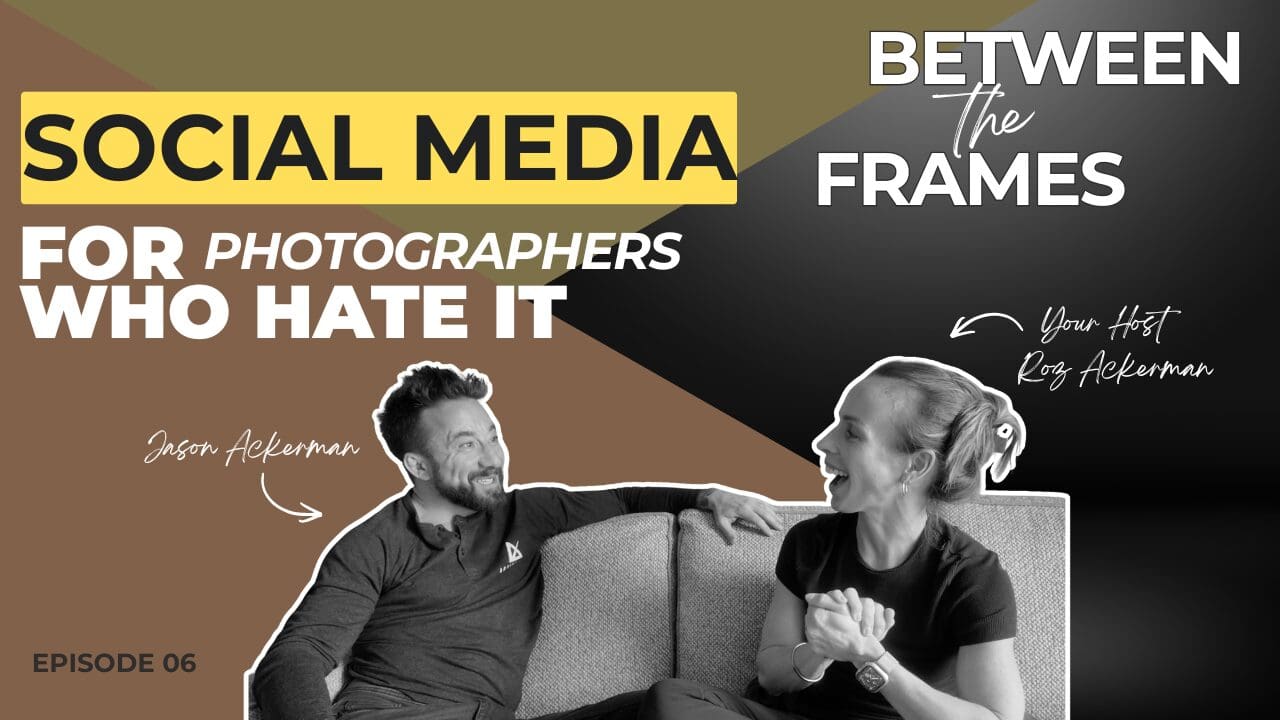
If you’ve ever said “I hate social media” out loud — same. And honestly, I think most photographers have been there. You got into this because you love making beautiful images, not because you wanted to become a content creator. That tension is real, and it’s worth naming.
In this episode of Between the Frames, my husband Jason and I had a really honest conversation about why so many photographers dread social media — and what it actually looks like to shift that. Here’s the condensed version.
Why Photographers Hate Social Media
There are a few buckets this tends to fall into, and you’ve probably felt all of them at some point.
You just want to share your art
Not be an influencer. The pressure to perform online can feel completely at odds with why you picked up a camera in the first place.
It’s a time suck — and an addictive one
You open the app to post and lose 45 minutes. For photographers who are also moms, this hits differently. You’re already stretched thin, and social media is specifically designed to keep you scrolling.
You don’t know what to post
Decision fatigue is real. When there’s no system, every post feels like starting from zero — and when something flops after you’ve spent an hour on it, it’s demoralizing.
Comparison quietly wrecks you
The algorithm shows you everyone’s best work. Measuring your behind-the-scenes against someone else’s highlight reel is a fast track to feeling like you’re not enough.
The Mindset Shift That Actually Helps
The first thing? Stop saying “I hate social media.” If that’s your story, you’ll keep living it.
Here’s the reframe: your social media is your storefront. Jason put it perfectly — we walked past a shop one evening that had people inside, but it looked dark and closed from the outside. No one went in. That’s what an inactive feed looks like to a potential client. They’re not going to think your business is closed — they’re just not going to think of you at all.
You don’t have to love social media. You just have to show up with intention and be consistent enough that the light is on.
Don’t Obsess Over the Numbers
If you’re newer to posting, a reel with 200 views can feel discouraging. But think about it this way: if 200 people showed up to hear you give a talk, you’d be thrilled. The scale feels different online, but the reach is real.
And as a photographer, you don’t need a million views — you need the right people to find you. One post led to an inquiry for a grad session within 24 hours of me posting. That’s social media working exactly the way it should.
Be Authentic — Or It Will Feel Icky Forever
A big reason social media feels uncomfortable is because we’re trying to do things that aren’t us. You don’t have to do trending audio that makes you cringe. You don’t have to talk to the camera if you’re not ready. Start with what feels true to you and expand from there.
The photographers who stand out aren’t the ones copying what’s trending — they’re the ones who let their personality come through consistently. Your style, your voice, your way of working with clients. That’s what separates you in a saturated market.
A Simple Framework to Get Started: 4 Content Categories
If you have no idea what to post, this four-category framework removes most of the guesswork. Rotate through these and you’ll never stare at a blank caption box again.
1. Education
Teach your clients something that reduces their anxiety about booking or showing up to a session. Think: what to wear, what to expect, how you help nervous families relax. This content attracts your ideal client and communicates your style before they ever reach out.
2. Showcase
Share your work — but give it context. Don’t just post pretty photos. Tell a story: how you met this family, what went sideways during the session, what the images mean. That’s what makes someone stop scrolling. Text overlay on images is working really well right now too.
3. Personality
Show your face. Show who you are. Potential clients — especially for newborns, weddings, or family sessions — are hiring a person they need to trust with their most important memories. If they can’t find you on your own feed, that’s a problem. Start with branding headshots if talking to camera feels like too much, and build from there.
4. Engagement
Prompt your audience to interact. Ask them to vote on a gallery cover image. Tell them to save a post for later. Ask where their dream session location is. Keep the ask simple — five choices max — and you’ll be surprised how much response you get.
For a deeper dive into showing up on Instagram specifically, check out my post on standing out on Instagram in 2026 as a photographer.
How to Keep It Manageable
Block time in your calendar. If social media doesn’t have a dedicated slot, it won’t happen — or it’ll eat into everything else. Even 20–30 minutes a few times a week adds up.
Start with a sustainable posting rhythm. Three times a week is a great goal. Once a week is infinitely better than zero. Don’t get fired up listening to this and commit to posting every day — you’ll burn out. Find your floor and build from there.
Use the Edits app for inspiration. It’s cleaner than scrolling Instagram, more niche-specific, and shows you what’s actually trending. Way less of a rabbit hole.
Set time limits on your phone. You can override them, but that moment of “oh, I went down a rabbit hole” is genuinely useful. Don’t beat yourself up when it happens — just close the app and come back tomorrow.
You Should Feel This Way
One last thing, because I think it matters: if you’re overwhelmed, behind, and exhausted trying to keep up with your business and social media and motherhood — that’s not a sign you’re failing. That’s just what this looks like. Pressure is a signal that growth is happening. It doesn’t mean something is wrong with you.
The photographers who make it aren’t the ones who never struggle. They’re the ones who keep showing up anyway.
If you have questions or want to share how this landed for you, I’d love to hear from you — drop me a note here.
Between the Frames: Episode 6 Transcript
Social Media for Photographers Who Hate Social Media
Between the Frames with Roz Ackerman — Episode 6
Roz: If you’ve ever said that you hate social media, this episode is for you. Welcome to Between the Frames with Roz Ackerman. Today I also have my husband joining me again for this conversation — Jason Ackerman. Welcome back.
Jason: Thanks for having me back.
Roz: So this episode, like most of my episodes, is geared towards photographers. But if you are a creative entrepreneur and you have found yourself saying those very words — that you hate social media — then you’re in the right spot. Because we’re going to dive into how we can change that mindset and how we can have this amazing resource work for you, without you feeling like you hate your life, like social media is a huge time suck, or that you’re just doom scrolling and getting lost in a world where you feel inadequate. It can be really demoralizing sometimes. So let’s get started.
I think a lot of entrepreneurs, but specifically photographers, hate social media because you want to be in that space to share the art you’re already creating — but you’re finding that you also have to be some kind of content creator or influencer. And when you’re like me, early 40s, that feels a little icky.
Jason: Definitely. I think any small business owner — and honestly, anyone on social media — will say at some point, I hate this, I don’t want to do it, I don’t get it. And insert any entrepreneur here. But if you own a business and you want other people to find out about it, let’s be clear: you need a presence. We were walking around the corner last night and I said social media is like having a light on. There were sales signs in a shop window, but from the outside it looked closed.
Roz: It totally looked closed. It was dark. I didn’t see an open sign. I honestly couldn’t even see any people inside.
Jason: There were people inside — but it looked closed. And that’s social media. If you don’t have a presence, people might not think your business is closed, but you’re not going to come up in searches. And if I were comparing two photographers and one had a more frequent, active presence — first of all, I’m going to see their stuff. I’m going to get to know their work and their style, but also it just strikes me as someone who’s more on top of their business.
Roz: Exactly. It makes you look busy. It gives this perception that this person is running a business, she’s doing stuff, she’s active. I will look at people’s accounts and not even look at how many followers they have. I’m just like, this person is busy. They’re doing all the things. They look awesome.
And going back to the shop analogy — that is exactly what your social media is, especially if you’re a photographer who doesn’t have a physical place of business. It is your storefront.
Jason: Multiple things can be your storefront — your website, your social media. But I find myself, even at 48, looking more on Instagram for businesses. The other night you were like, what are you looking at? And I was like, gym equipment. I’ll find something I like and then go to their bio to see if they have a website. I think you absolutely need a website, but it can just be: here’s my name, here’s my email, here’s my phone number. Social media is acting as your portfolio, your blog — all of the things. It’s window shopping, but online.
Roz: That makes so much sense. When I research things online and have a billion tabs open, it gets so overwhelming I’ll just close it all. Instagram is way cleaner. You find a reel you like, you save it to a collection. Done.
10:14 Why Do We Hate Social Media? The Buckets
Jason: So when you talk about social media — why do people dislike it? You can typically lump it into a handful of buckets. I don’t know what to post. I feel less than because of comparison. How often should I post? And especially for your audience: it makes me feel like I’m not present.
Roz: The presence thing is really real, especially for photographers who are also moms. You have a finite amount of time every day. You might be editing galleries, responding to inquiries, writing blog posts — and the work doesn’t even end when you post. You have to go back and engage. You can’t just dump some photos and close the app.
Jason: Here’s something that might come off as harsh: if any of those excuses resonated with you — great. You’re entitled to them. And it doesn’t matter. You still need social media for your business. The point of this conversation is that those feelings are normal. You have them. I have them. Roz has had them.
Roz: I literally remember saying I hate social media a year ago. I still sometimes do. But here’s the thing: we have to make social media work for us. No different than how we all have different methods and styles for everything else — figure out what’s going to work for you.
13:27 Stop Saying “I Hate Social Media”
Roz: First, just stop saying that phrase to yourself. I hate social media. That needs to be done. Stop making it your story. The reality is you need a presence. So what can we say instead? It is an amazing tool to showcase what you do, your work, and who you are as a person. You can reach your ideal clients through this platform.
And do not focus on the numbers — I only have X followers. Don’t worry about that. Say your post gets 12 likes and one new organic reach. That person could be your next client. You don’t need a hundred new followers from every post.
Jason: If you put up a reel and 200 people saw it — that seems insignificant compared to some accounts. But if 200 people showed up to listen to a talk you gave, would you be happy? Yeah, you’d be thrilled. You have to reframe it.
Roz: Yes! I’ve seen posts like that — someone surrounded by 500 people, saying, this is what your 500 followers actually looks like. It’s mind-blowing.
Jason: And as a photographer, if you’re truly trying to grow your business, a million views doesn’t help you if they’re not in your neighborhood. You want the right people to see your work. You did graduation pictures a few weeks back for some girls, and within 24 hours of posting, you got an inquiry through Instagram for another grad session. One post. That’s social media working.
24:55 Be Authentic — Use It Your Way
Roz: Going back to why it can feel icky — I think it’s because sometimes we’re not being authentic to ourselves. You don’t have to go on there and do whatever is trending if it makes you cringe. I cringe when I hear my own voice in behind-the-scenes footage. I cringe sometimes when I see reels I’ve put out. But I go into it knowing I’m having fun and not doing anything that isn’t my style or personality. Yes, it’s outside my comfort zone — especially talking to the camera, which I really hate. But if you are being true to yourself, it’s going to be received well.
Jason: And part of being an entrepreneur is getting out of your comfort zone. I think your listeners are badasses. You’ve already said, I am going to buck the normal societal trends, be an entrepreneur, make my own money, create my own schedule. That takes courage. Challenge yourself, grow, leave your comfort zone — and you’ll be better not just on social media, but in your interactions with clients and how you show up for your family.
29:08 Reframe: You Should Feel This Way
Jason: As an entrepreneur, you should feel like you have a million things to do. I remind my gym clients of this all the time — this is normal. I want to share a story. I did a 24-hour overnight event a couple years ago. Cold, in the mountains, carrying a 55-pound weight through the woods at 2 in the morning. At some point I just stopped and had a little pity party. And then I thought: it’s 2 AM, I’m cold, I’ve got 55 pounds in my arms — I should feel like this. And that instant reframe — I should be feeling this, this is part of it — completely changed everything.
It’s the same for entrepreneurs. You should feel tired. You should feel like you have a million things to do. That pressure is actually a signal that growth is happening. Pressure makes diamonds.
Roz: I love that. “The business will be there tomorrow” has become my new mantra. Because I have a problem where I can’t stop. But having that perspective helps.
36:57 The Comparison Trap
Roz: Lately, when other photographer friends tell me, oh my gosh, you’re doing so great on social media — I want to say, do you realize the chaos that is happening at home for me to get this out there? It is not easy. But I’m still making it happen. And if I can be consistent, and turn social media into a tool I actually enjoy and use to build community — then I truly believe you can too.
Jason: We often look at our inadequacies and forget all of our strengths. Maybe whoever is listening right now is great at talking in front of a camera. Or great at black and white photography. Or great at something else entirely. Don’t compare your behind-the-scenes to someone else’s highlight reel.
Roz: Whatever someone else has to offer, you have different things to offer. Lean into your strengths and who you are as a person. That is what will separate you. If you feel like it’s super saturated out there — that’s exactly why you’re going to include your personality in your content.
40:08 Practical Strategy: The 4-Post Framework
Roz: Okay, let’s get into some practical things you can start doing. First — decide on your weekly content rhythm. How many times a week do you want to post? What feels sustainable to start?
Jason: What’s the bare minimum for a new photographer?
Roz: I would say try to post three times a week. And if three is too much, start with once. Once a week is 52 more times a year than zero. Start with whatever is sustainable, and you’ll build from there.
Jason: Don’t listen to this podcast, get fired up, decide to post every day, and then burn out and stop. Find a consistent rhythm first.
Roz: Agreed. Okay, and for what to post — I have a four-post framework that I love. These are four content categories you can rotate through so you’re not always posting the same type of content.
41:56 1. Education
Teach your clients something that reduces their anxiety about booking or showing up to a session. For example, a reel about awkward clients — something like “dear algorithm, send me all the awkward couples” with behind-the-scenes footage of you helping a couple relax. That immediately connects with someone looking for a photographer who can make them feel comfortable.
As photographers, we sometimes forget how vulnerable it feels to have your picture taken. So education content does two things: it reduces your client’s anxiety, and it communicates your style. You’re telling them: this is lifestyle photography. It’s candid. We’re not doing the “say cheese” thing.
Jason: And I’d add — educate the woman, because she’s typically the one booking. Women want pictures; men typically take more convincing. So if you can educate her on how to get her husband on board — how to pick his clothes, how to make him feel comfortable — you’re removing friction before the session even starts.
46:27 2. Showcase (with a note on Unreasonable Hospitality)
Show your artistry — but give it context. Don’t just dump pretty photos. Add a story: what happened during the session, how you met this family, whether they’re long-term clients, what the meaning was behind the images. Make it personal so that someone reading the caption feels something.
Text overlay on images is also performing really well right now. And it will immediately attract your ideal client.
Jason: Your recent post about Bodhi’s third birthday is a perfect example. The pictures speak for themselves, but there was a whole story behind them — the knocked-over plant pot, the shattered pottery, the uncooperative toddler.
Roz: I didn’t even realize I was doing it. Once you start doing these things more regularly, it becomes habitual. You don’t have to think so hard.
Jason also recommends Unreasonable Hospitality by Will Guidara — a great read on going above and beyond in client experience, which applies directly to how you show up for your photography clients.
49:59 3. Personality
You have to show who you are and show your face. I get frustrated when I go to a creator’s account and I’m like, who is this person? I’m scrolling through and I can’t find them.
Your profile photo should be you — not your logo. And you need personality content on your feed too. If you don’t like talking in front of the camera, start with branding headshots. Or share behind-the-scenes where you’re directing clients. Your audience, your potential clients, are learning how you interact with people. Even if you hate the sound of your voice, it needs to go out there.
Jason: Posts that start with someone’s face perform better than posts that don’t. And in photography especially — clients are hiring a person. They need to ask themselves: can I trust this person with my biggest memories?
I’ll add a tip for anyone who struggles to talk to camera: set up your phone and explain something to a friend or your spouse in real life, without thinking about the camera. People who think they’re bad at talking aren’t bad at talking when they’re actually talking to someone. Record that, and post it.
Roz: That’s so true. That’s also why I have my husband on these episodes — I’m not used to delivering information on my own. A conversation just feels more authentic, more inviting. It resonates better.
Jason: And speak simply. Albert Einstein said if you can’t explain something to a kindergartner, you don’t really understand it. The average adult reads at a third-grade level. If you speak simply, you appeal to everyone. I’ve literally plugged my own writing into AI and said, make this a third-grade level.
56:06 4. Engagement
This is about prompting your audience to comment, save, or share. It can be super simple — like, “which photo should I use as my gallery cover?” and post five options. I guarantee that will get engagement. People love being asked for their opinion.
Other ideas: “send this to a mom who needs to book a session,” or “save this for fall — here’s what to wear at a fall photo shoot.” Keep it simple, keep the choices limited — five options max.
1:00:11 Keeping Social Media Manageable
Roz: Okay, a few tips for keeping this sustainable.
Block time in your calendar. If it’s hard for you to sit down and make time for social media, create an appointment with yourself. It’s 12 o’clock on Tuesday — I am going to create content. Treat it like a client spot.
Jason: Set a Pomodoro timer — 25-minute blocks. Put your phone on focus mode. Do it.
Roz: And be intentional when you’re scrolling. Instagram is designed to keep you on it. You will get sucked in. You need to have the presence of mind to know why you’re on there.
If you’re looking for inspiration, I’ve really been loving the Edits app. It’s way more specific to your niche — essentially just reels, filtered to what’s relevant to your business and what’s trending. I love going on there versus Instagram for inspiration. You can see what’s performing well and then tweak those hooks and ideas to fit your own business.
Jason: You can also set time limits on your phone. My Instagram times out after a certain point. You can override it, but at least you get that moment of — oh, I went down a rabbit hole.
Roz: And don’t beat yourself up when it happens. If you doom scroll, chalk it up, close the app, and come back tomorrow. It doesn’t mean you’re going to fail at this forever.
1:04:17 One Last Tip: Build a Clip Library
Roz: If you find it hard to create content — specifically reels — make a list of what types of video clips you need, and go film them in a batch. I went to the studio one day and spent an hour just filming myself: holding the camera, taking my lens cap off, spinning around, fluffing my hair. Ridiculous clips. But they’re the essential building blocks you need to create reels.
You don’t have to go to a studio either. Film yourself as you go about your everyday life. And don’t think that the video in the background has to connect to the text overlay. Sometimes the text says one thing and you’re driving in your car in the background. That’s fine — it’s just giving movement to your message.
Jason: And repurpose them. Use them again. Don’t be precious about it.
Roz: Don’t let perfection be the enemy of good. Get it out there. You gotta show that you have a light on in your store.
Jason: The big picture: social media is here. It’s part of your life and your business, and it’s more than likely not going anywhere. Find a rhythm that works, be consistent, and don’t be perfect — just get doing it. Check out Roz Ackerman Photography, and tell a friend that Roz Ackerman has a podcast. And every once in a while, her husband’s on it.
Roz: You don’t want to miss those episodes. All right, good deal.
Listen to Between the Frames with Roz Ackerman wherever you get your podcasts, and find Roz at rozackermanphotography.com and on Instagram @rozackermanphoto.
Leave a Reply Cancel reply
Honest, heartfelt portrait and elopement photographer for modern women and the families they center. Serving Denver, Boulder, Arvada, Lafayette, Louisville, Superior, Westminster and the Colorado Front Range. Available worldwide to tell your story.
ROZ ACKERMAN


©2026 | ROZ ACKERMAN photography
©2026 | ROZ ACKERMAN photography