July 8, 2026
Client Privacy in Photography: Why More Clients Don’t Want Their Photos Shared (and What I Changed in My Contract)
Client privacy in photography used to be a kids-only conversation. A parent would ask you not to post their child’s face, you’d make a note in your gallery software, and that was that. But over the past year, I’ve noticed something new: adults are asking for complete privacy too. Couples. Maternity clients. Entire families. No Instagram, no website, no blog — nothing shared, anywhere.
I’ll be honest, my first reaction a while back was, “That’s a little strange, right? Why would a grown adult care?” If you’ve had that same knee-jerk thought, this post is for you — because once I understood the reasons behind these requests, it completely changed how I write my contracts and how I talk to clients.
Why are clients requesting privacy — even adults?
There are more legitimate reasons than most of us realize, and almost none of them have anything to do with your work.
AI scraping. When you post images publicly — your blog, your Instagram, your portfolio site — AI companies can and do sweep them up to train their models. Nobody asks permission, and there’s no undo button once an image has been scraped. For a lot of clients, opting out of being posted is the only form of control they actually have. That’s not paranoia; that’s just how the internet works right now.
Professional footprints. Teachers, therapists, law enforcement, healthcare workers — plenty of people are required (or strongly motivated) to keep a nearly invisible personal presence online. They don’t want a student, patient, or client stumbling onto their family photos. It’s not about you. It’s about their Tuesday morning at work.
Safety. Some clients have left abusive relationships, others have custody situations and some simply have a person in their past they never want finding them. These clients will rarely explain why they’re asking, and they shouldn’t have to.
Once you see the list, the mindset shift is pretty simple: a privacy request isn’t a rejection of your work. If anything, it’s a sign of trust — they’re hiring you because they believe you’ll protect them.
The mindset piece: who is this work actually for?
Here’s where I’ll say the thing that ruffles feathers. I know photographers who get genuinely upset when a client requests total privacy after a beautiful session. And look — I do get it. Sometimes it’s your best work and you can’t show a soul.
But we’re doing this work for our clients. They requested it, they paid for it, and it exists to live on their walls and in their family’s memory — not to live on our feeds. We’re allowed to feel a little bummed. We’re not allowed to make it their problem.
What to put in your photography contract
This is the practical part, and it’s what I changed in my own business. My advice: stop treating the model release as boilerplate your clients skim past, and start treating it as a real choice you’re offering them.
Instead of an automatic “I can share your images” clause buried in the fine print, consider offering tiered privacy options with checkboxes, something like:
- Full sharing — I can use images for my portfolio, website, social media, and marketing
- Limited sharing — images may be shared without identifying details (no names, no faces — think side profiles, hands, silhouettes, blurred motion)
- Complete privacy — no images shared anywhere, period
Two things matter here. First, define what “complete privacy” actually covers in writing: no social media, no website, no blog, no vendor or publication submissions, no email marketing. Vague language helps no one. Second, let clients choose this upfront, at booking — not awkwardly after you’ve already posted a sneak peek.
I’ve had clients land at every tier. One mom was happy for me to share images as long as her child’s face never appeared. Another wanted nothing shared at all. Recent couples sessions — adults, no kids involved — chose complete privacy too. Every one of those sessions was still a joy to shoot.
If you’d like the exact privacy language I use in my contracts, send me a DM on Instagram @rozackermanphoto or reach out via email and I’m happy to share it.
But what about your portfolio?
This is the honest tension: if a growing chunk of your work can’t be shown, how do you market your business? A few workarounds that don’t compromise anyone’s privacy:
Styled sessions and model calls
I know there are two camps on styled shoots, but there’s nothing wrong with creating work specifically for your portfolio — with participants who enthusiastically consent to being shared. Do a model call. Photograph friends who are genuinely happy to be your marketing material.
Anonymous storytelling
Details, hands, silhouettes, backlit moments where no one’s identifiable. Some of the most emotive images in my portfolio don’t show a single face clearly — and that actually aligns beautifully with documentary-style work.
Ask per image
Some “complete privacy” clients will surprise you and approve one specific frame if you ask kindly and specifically. The worst they can say is no — and respecting that no is the whole point.
The Photographer Horror Stories (because it wasn’t all serious)
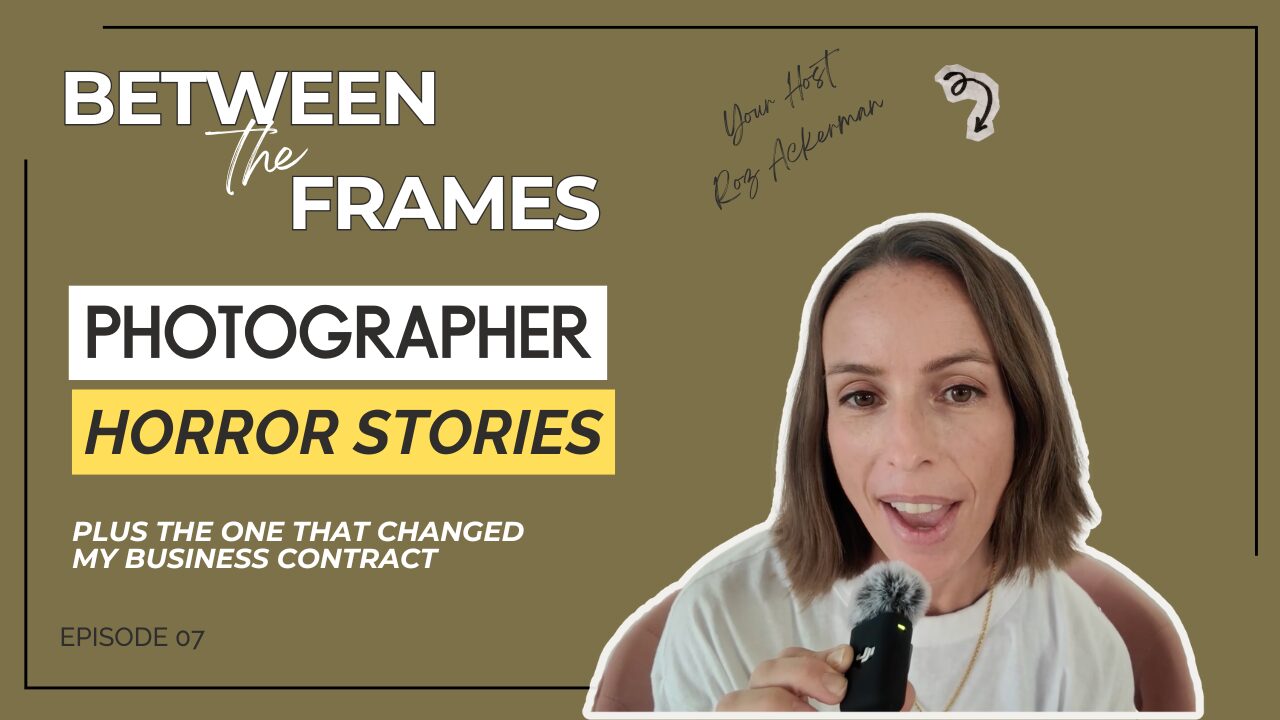
The privacy conversation was actually the closer of a much sillier episode. In the full episode I get into the five photographer horror stories that still make my stomach drop, including the time I formatted an SD card and dropped my only backup hard drive onto a hardwood floor, the mid-session dial bump that has us all quietly shooting at f/12, the wedding guest who wants to discuss sensor technology while you’re working, losing a client literally as the contract was going out — and the maternity session where I did a deep squat directly onto a cactus. Yes, as you can imagine, there were spines, there were tweezers and yes, my husband was involved in the removal process.
You can hear all of them (and the full privacy conversation) on Episode 7 of Between the Frames. Click on the episode link at the beginning of this post to listen in, or you can watch the full episode on my YouTube channel.
This episode of Between the Frames is sponsored by Ruby & Rae camera bags — enjoy 10% off with the code BETWEENTHEFRAMES10.
EPISODE TRANSCRIPT
Between the Frames with Roz Ackerman
Episode 7 — Photographer Horror Stories
[00:18] — Sponsor pre-roll
Hey guys, before we get into it, this episode is brought to you by Ruby & Rae camera bags. And I just want to say that I don’t personally recommend products that I don’t already know and love. So when I tell you that these bags are incredible, I really mean it. Personally, I own the Ruby backpack in black, and I also have their limited edition checkered Sidekick bag. Aside from the fact that these bags are incredibly functional and fashionable, I love that you can pull the camera padding out and just use them every day. Ruby & Rae is generously providing an exclusive offer to my listeners, so you can save on all Ruby & Rae products in their online store — just use the code BETWEENTHEFRAMES10 at checkout. I’ll drop the code and the link to Ruby & Rae in my show notes. Okay, without further ado, let’s dive into today’s episode.
[01:20] — Welcome & life update
Hi guys, today we are talking about photographer horror stories. I don’t know about you, but I feel like every photographer has that one story that still makes their stomach drop. So we’re going to dive into some of those. I have five kind of funny ones — funny in hindsight — and one that actually changed how I run my photography business.
[01:45] Before we dive in, a quick little recap of some things I’ve been up to. I had some Flower Farm mini sessions last weekend, and they were really fun, but they did remind me how hectic they feel. I like to run my mini sessions a little longer now — I offer 25 minutes, sometimes up to 30. And honestly, I don’t typically call them mini sessions; I try to avoid that language. But I think everyone recognizes: okay, these are discounted sessions, maybe they’re run back to back, the photographer is picking the date and the location, and you just choose your favorite time slot. There’s definitely a lot of benefit to running mini sessions. I think you can earn quite a bit of money from them, even if you’re offering them at slightly discounted rates up front.
[02:45] Anyway, I had planned them at Boulder Flower Farm, and I was planning on leaving an hour before my first session started, which was going to give me about 30 minutes at the flower farm just to walk around, look at the lighting, get some behind the scenes. I was actually going to try and make a whole vlog about it. So I jumped in the car, left an hour early — [03:09] and the highway I was supposed to take was closed. There was a really terrible accident. I don’t know if anybody was seriously hurt, but they closed the highway in that direction toward Boulder. And even though the alternative route wasn’t that much longer, there was just a lot of traffic trying to figure out where to go.
It was immediately stressful. I arrived minutes before my first couple did — and they were early. And the flower farm was supposed to leave bouquets out for everyone, and I couldn’t find where they were, so I was running around looking for those too, because I wanted to make sure everybody knew where to pick them up, and I knew I wasn’t going to have time to do that between sessions.
[04:05] So — stress. But they still went well. Am I going to be able to provide everyone with gorgeous full galleries? No, that’s not the point of a mini session. Am I going to be able to provide them with 15 to 25 awesome images? Yes. They were really great, and I’m thinking about maybe doing some more later in the summer because they were super popular. It was so funny — literally every single one of my sessions except one was a maternity-focused session. I kind of love how that worked out. I guess the moms were just feeling drawn to flowers.
[04:58] What else have I got going on? I feel like I had a long list and foolishly did not write it down. I do have a trip coming up on Monday — I’m headed to Crested Butte, which I’m super excited about. I have been dying to go there and photograph the wildflowers, and I’m doing a little bit of a content retreat there, so that’s going to be super fun.
[05:14] Other than that, today I am standing at my desk, and I’m kind of glad you can’t see the disarray of my desk right now. Me from even five years ago — definitely ten years ago — would be freaking out about this mess. I used to be extremely type A, and I don’t know if it’s children, or being an entrepreneur, or being a creative — maybe it’s all of those things combined — but I’ve noticed I’m tolerating a little more mess here and there. Don’t get me wrong, I do eventually need a clean space to really get focused. But I’m just too tired to care right now, I think that’s what it is. And I’m standing because I want to make sure I’m not sitting too much — it’s not good for my back, and my back is sore, so we’re standing today.
[06:10] — Story one: SD card and hard drive malfunctions
All right, let’s dive into today’s episode. We’re going to start with the first story, and I think every photographer can relate to this. Maybe you’re like me and you have to check what feels like a million times that your SD card is good — and then when you get back, that you’re backing everything up. This story, or category of horror stories, is some kind of malfunction with your SD card or your hard drive. Whether that’s accidentally formatting your SD card before you’ve safely downloaded all the images or delivered the gallery, or you’re in the middle of a session and your SD card suddenly comes up with a corrupt message. Oh my God, so stressful.
[07:05] Fortunately — touch wood — I don’t think I’ve had the corrupt SD card message. But I did erase an SD card. [07:16] I formatted it, and I was working with a really old hard drive at the time. I was just like, let me save some money and use this super old hard drive — we’re talking ten years or more old. It still works, it’s fine.
I was trying to move from one spot to another, like you do when you work on a laptop and you’re looking for a quiet area in the house. And I think you can guess what happened. My hard drive was plugged into my laptop, balancing on top of it. I truly don’t know what happened — I moved too fast — but it fell. The weight of it caused the cable to unplug from my laptop, and it dropped straight onto the floor. We have hard wooden floors throughout our home. And, well, you can guess. It just didn’t work after that. [08:12] It was making some gnarly noises when I plugged it back in, just whirring — clearly all the mechanics in there got misaligned.
[08:45] I almost tried to send it off to get fixed, because I discovered that not only had I formatted the SD card that gallery was on, but my only backup was on this external hard drive — and I hadn’t imported those photos into Lightroom yet. I don’t know about your workflow, guys, but when I add my photos into Lightroom, I also create a backup where they link to my cloud. I remember telling somebody about this once and they were like, “You do what now?” I don’t know, this is how my brain works. So all my RAWs are essentially in the cloud, and I feel like they’re safe there. But I had not imported these into Lightroom, so they were not in the cloud, and yes — I lost an entire gallery.
I will say it was kind of fortunate in one way. This was actually for my builder — I do some interior and architectural-style images for him every now and then. It’s so fun; I get to go hang out in really beautiful custom homes and take photos. It’s so peaceful, I love it. So I was bummed, but luckily it was my neighbor’s home, so I was able to set up another appointment. Honestly, if that had been a family session or any other kind of session, I would have been mortified. I don’t know what I would have done — I would have cried about it, for sure. Luckily it wasn’t a huge deal; it just cost me time.
So, lesson for you guys: if this has not happened to you yet, make sure you are backing up your files onto a safe hard drive and putting them into a cloud. You can’t just rely on an external hard drive as your safety net — because what if something happens to your external hard drive? And before you format those cards, make sure you have that dual backup system securely set up.
[10:40] I’m trying to think if there’s other malfunctioning stuff. I was on a retreat in Utah in April, and somebody’s camera suddenly decided it wouldn’t turn on anymore. It would technically turn on, but the screen was completely black. And I was like, okay, that’s concerning — especially when you only have one camera with you. It’s made me freak out to the point that I just recently got a second camera. I feel like I’m constantly preparing for contingency situations now. What if my gear breaks? What if something goes wrong? Obviously there’s only so much you can do, but I do think having backups available to you is important.
[11:21] — Story two: the dial bump
Moving on. Second horror story — the dial bump. Let’s just call it that. I don’t think I’m alone here; I’m sure this has happened to you. Most of the time it’s accidental. Or you deliberately change the settings on your camera and then forget to change them back.
[11:44] For me, that can happen when I’m trying to create blurry images. I’ll bring my shutter speed down and have my f-stop at like 12 to 15, something like that. Then maybe I dial my aperture back but forget to change my shutter speed, or I adjust the ISO — things get crazy. So there’s the deliberate-but-forgetful version. And then there’s the purely accidental version: you’re carrying your camera — maybe on a strap, maybe in your Spider Holster, however you carry it — and you accidentally hit one of the dials without noticing. Then you adjust something else because the lighting seems slightly off, and now everything’s compounding.
[12:45] This has definitely happened to me. I feel like I can shoot for about five minutes like that before I catch it — I periodically take quick, intentional breaks just to look at what I’m getting, and my screen shows the settings info, so that’s when I figure out that, oh dear, I’ve messed things up. But sometimes it doesn’t happen right away, and you don’t realize until much later. And that really sucks.
[13:23] If this has ever happened to you, just know that it happens — even to experienced photographers. It can be completely accidental. You’re not alone. Try to brush it off, and if you have to repeat something you already did with your clients, just handle it in the moment. You could be honest with them, but I don’t think you need to be. You can just say, “Hey, I really loved that pose we were doing earlier, but I love the lighting here” — or the backdrop, or whatever it is. Try to redo it in the moment rather than waiting until you get home and trying to fix it in post — that’s going to be so much harder. Usually your clients are so preoccupied with everything else that’s happening, they’re not really aware they’re repeating poses.
[14:08] — Story three: the gear buff
This one is funny. I feel like wedding photographers are especially going to relate, because this happened to me when I was shooting a friend’s small, intimate wedding. I’ll call this one the gear buff — the professional photography hobbyist.
This has actually happened to me at another wedding too. People will come up to you, they see you with the camera, and they’re like, “I used to do photography.” And they’ll start talking to you about their photography journey and what they used to shoot, and then they start getting really technical. [14:58] And I’m like — dude, I am self-taught. I know a lot about how to make pretty images, but I don’t understand all the technical stuff. I’m not reading my camera’s manual — which I know my dad definitely did. I’m so impatient. I don’t have time for manuals, period.
[15:30] If I get a new camera — which I did; I have the Canon R6 and I recently got the Mark II, and I love it — there are a lot of new autofocus features on it. Rather than read the manual, I was like: YouTube, educate me. So I went on there and figured out all the new settings.
[16:17] I’m just not someone who’s great with all that technical jargon. But you will definitely encounter these types of people, especially at weddings, and they’ll want to talk to you about your settings, your gear, what type of lens you’re using. The questions I get asked most now are about the change from DSLRs to mirrorless. And I’m like — I don’t know! I shot with a DSLR at least ten years ago, and as soon as I came back to being a professional, I got myself a mirrorless. So don’t ask me about DSLRs, okay?
[16:39] All right, we are whipping through these. I do want to keep this episode short today, because my kids are coming home very soon. I’m recording this on July 3rd, so their preschool summer session is on vacation today. I feel like I’m constantly squeezing in these episodes around when my kids are out of the house, because obviously I need the place to be quiet. We actually contemplated building a soundproof podcast box for my husband when we were custom building this home — and we didn’t, and I kind of regret it now. I never thought I’d be recording my own podcast, but here we are.
[17:27] — Story four: losing the client mid-contract
Okay, story number four. This one is so sad, and it happened to me recently. [17:36] I was texting back and forth with this person all morning. I was looking at locations for them, kind of trying to prove my worth. And I was literally in the middle of getting her contract done — I was about to send it out — when she texts me: “I don’t know how to tell you this. I’m so sorry.” Her niece, I think it was, had connected her with another photographer who was offering the session at an incredible discount. So good she couldn’t walk away from it.
I was so bummed. It was going to be a really beautiful extended family session, and I had put a lot of work into it. I think clients forget this when they’re thinking about pricing — I can spend almost an entire day communicating with you and providing you with location information. [18:45] And this was a good little lesson for me. I was being careful and trying to maintain some boundaries, but: do not dive down a rabbit hole of giving your client specific location recommendations, or doing that research for them, until you have a contract locked in. You will potentially be doing work and not getting compensated for it.
[19:17] That one hurts a lot. And maybe losing a client in that exact situation isn’t super common, but I do find clients are price shopping — a lot of them are — so you want to be mindful of that. I hate to say how significant speed is, but literally, if I had gotten that contract to her an hour earlier, she would have signed and paid the deposit. And then I would have been like, okay cool, you can go take that other session, but I just did all that work and you paid the deposit. Actually — I say that, but I don’t think I would be that mean. I probably would have said, “I understand, here’s your money back.” I don’t know. It’s tough.
And if that specific thing hasn’t happened to you, you’re probably familiar with being ghosted. That happens all the time. You’ll go back and forth, and then maybe they weren’t fully aware of the full scope of your pricing, or they got information from another photographer and thought, “Wow, this price is better, I’m going with them” — and they just never respond to you again.
[20:28] I actually had something like this happen recently, too. I sent pricing for a welcome party — the night or two before a wedding, not quite a rehearsal dinner, just a welcome party. And it was more than they wanted to spend, which is fine. I have to value my time at this point. I knew it was going to be a lot of editing, and there’s a lot of pressure that comes with those types of events. My pricing is what it is — I need to remind myself of this, because it does sting a little. I recently saw someone share their images from that welcome party, and I was like, ugh, I’m so bummed they got it instead of me. Which is terrible — I’m happy for them! But at the same time, it makes you question your own business practices. You’ve got to do what’s right for you. Pricing that makes sense for one person doesn’t make sense for another. It still stinks, though. You just kind of have to get used to it. [21:28] You get a thick skin in this industry.
[21:31] — Story five: anything for the shot
Okay, we’re at number five already. This one’s a funny one — I’m sure you’ve seen reels about this too, because photographers will literally do anything for the shot. [21:46] Climbing on top of cars, wading out into water, getting themselves into all these weird contortions just to get the shot.
We’re used to seeing the funny version — “you look so silly lying on the floor” — but actually, it can be pretty dangerous. A lot of the time you’re either looking at the LCD on the back of your camera or through your viewfinder. Sometimes you’re running with your client. Sometimes you’re running backwards. You really need to observe the space around you before you start doing those things. I have definitely almost — well, not killed myself, but severely injured myself — nearly tripping over huge boulders.
[22:40] But one time, I did a really deep squat onto a cactus. Middle of a maternity session. Sat on a cactus. It was obviously painful, and I didn’t even try to hide it — I was just like, “Oh my God, I just squatted on a cactus.” And the girl was super nice about it: “Oh my God, are you okay?” And I’m like, “I’m fine, let’s carry on!” Trying to pull the spines out of my butt and laugh it off. Totally fine, you know.
[23:11] We were actually heading to a second location for another part of the shoot, and I remember getting in the car and going: I cannot sit down right now. So I’m perched on one side of my butt, driving to the second location — which thankfully wasn’t far. I get there, and she hasn’t quite arrived yet, or she’s changing in her car, so I’m there pulling my shorts down trying to get the rest of the spines out.
[23:56] And I don’t know if you’ve encountered this — maybe it’s a Colorado thing, though it’s probably just a cactus thing — but you can get those really thick, long spines, and then you can get these really short, fine bristles that just embed in your skin. Honestly, I don’t know how you get them out. They break off, so you’ll have a tiny bit poking out, and anything that touches it is so painful. That was the situation I had going on. [24:18] I made it through the rest of the session, drove 45 minutes home on half of one butt cheek, and texted my husband on the way: “Babe, you gotta help me. I sat on a cactus. Get the tweezers ready.”
I got home — the kids were in bed already, I think — and I just lay on the bed and let him go to town with these tweezers. He could not get them. They were really deeply embedded. I think eventually they just made their way out on their own.
So, moral of the story: have some spatial awareness before you start running backwards or moving without looking where you’re going. And always take a peek at the ground before you decide to do a deep squat. Because you may just end up sitting on a cactus.
[25:12] — Story six: the privacy request — and what changed in my contract
Okay, number six. I’ve had some funny ones, and some kind of sad ones too. This one is actually impacting how I run my business now and how I’m catering to my clients in my contract. I think this will resonate with a lot of people: privacy has become a huge deal in the photography space.
Is it controversial? I think it might be. I know some photographers who get really upset when they’ve had a wonderful session and then the client requests total privacy — they don’t want any of their images shared anywhere. [26:19] And I just think we have to remember, as photographers, that we are doing this work for our clients. Our clients are requesting this work. So if they want total privacy, we have to respect that. Sure, you can be a little upset about it — maybe it’s some of your best work — but ultimately, we’re doing this work for them.
[26:39] I think it’s really important that you have something in your contract for this. I don’t think it should be an automatic “I’m going to share your images” clause — although you could have that as a starting point — with option boxes for different levels of privacy, if you want to offer your clients those options. And I do recommend this. Some clients are comfortable with you sharing images as long as you’re not sharing their identity, or not sharing their children’s faces. [27:04] I had one client who was okay with me sharing images as long as it was only a side view of her child, or blurry images. Then I had another client who wanted no images shared at all — that was for her and her son.
And some of my flower farm sessions — these were adult couples — didn’t want their images shared either. I have another maternity session coming up at the end of the summer, and they also don’t want those images shared. That may be perplexing: why do adults not want their images shared? But there can be many reasons.
There are the AI concerns we’re facing now — fears about how AI might be able to use your images or your face. [28:07] And then there are other reasons. Maybe your client is a teacher, and they keep a very small footprint online — they don’t really share themselves in a personal capacity because they have to maintain a completely professional appearance in the online world. [28:22] Teachers, law enforcement, therapists — of course those people are going to want privacy. I was definitely in that camp originally, thinking, “That’s weird, adults who don’t want their photos shared.” But when you think about the types of work they might be involved in, it makes total sense.
[28:51] And there can be scarier reasons too. Maybe they have a scary ex. Maybe they escaped an abusive relationship in the past. So try not to be judgmental, and try not to be too upset about it. You respect your client, and you hope you have another session where your work is also fantastic and that client is more than happy for you to share it.
[29:22] And there are other ways to cultivate portfolio-building work, too. I know there are two camps on this, but I think there’s nothing wrong with doing styled sessions. You can set one up for yourself. You can do a little model call. You could even use friends who are perfectly happy to consent to you using their pictures. There are lots of ways around this whole privacy issue that photographers are encountering.
I can’t speak today — my son woke us up at 5:30 again. Hopefully there’s going to be a podcast episode very soon where I don’t talk about my sleep deprivation. My three-year-old is really messing up my sleep cycles right now.
[30:03] So that was kind of the big one. If you want to know the exact language I include in my contracts, I’m more than happy to share that with you — feel free to send me a message.
[30:18] — Wrap-up
I hope you can take away some lessons from today’s podcast, especially about being prepared when it comes to our gear. Don’t take any chances with not backing up your images. [30:35] One thing I didn’t mention earlier: I never used to shoot dual-slot SD cards in my camera, even though I had the option — I always just used one. But now I always use two, no matter what. That way I can format one of those cards and keep the other one safe until the gallery is fully delivered. So that’s another little takeaway for you.
[31:05] If you have a horror story you would love to share with me — please, make me feel better, I would love that. You can DM me on Instagram, @rozackermanphoto, or I’ll drop my email in the show notes so you can grab it there.
And if you enjoyed this episode, please share it with another photographer. Don’t forget to rate the show, subscribe, do all the things. [31:28] One final reminder that this episode was sponsored by Ruby & Rae — I’ll drop their discount code in the show notes as well.
All right guys, have a great week. Bye!
Leave a Reply Cancel reply
Honest, heartfelt portrait and elopement photographer for modern women and the families they center. Serving Denver, Boulder, Arvada, Lafayette, Louisville, Superior, Westminster and the Colorado Front Range. Available worldwide to tell your story.
ROZ ACKERMAN


©2026 | ROZ ACKERMAN photography
©2026 | ROZ ACKERMAN photography