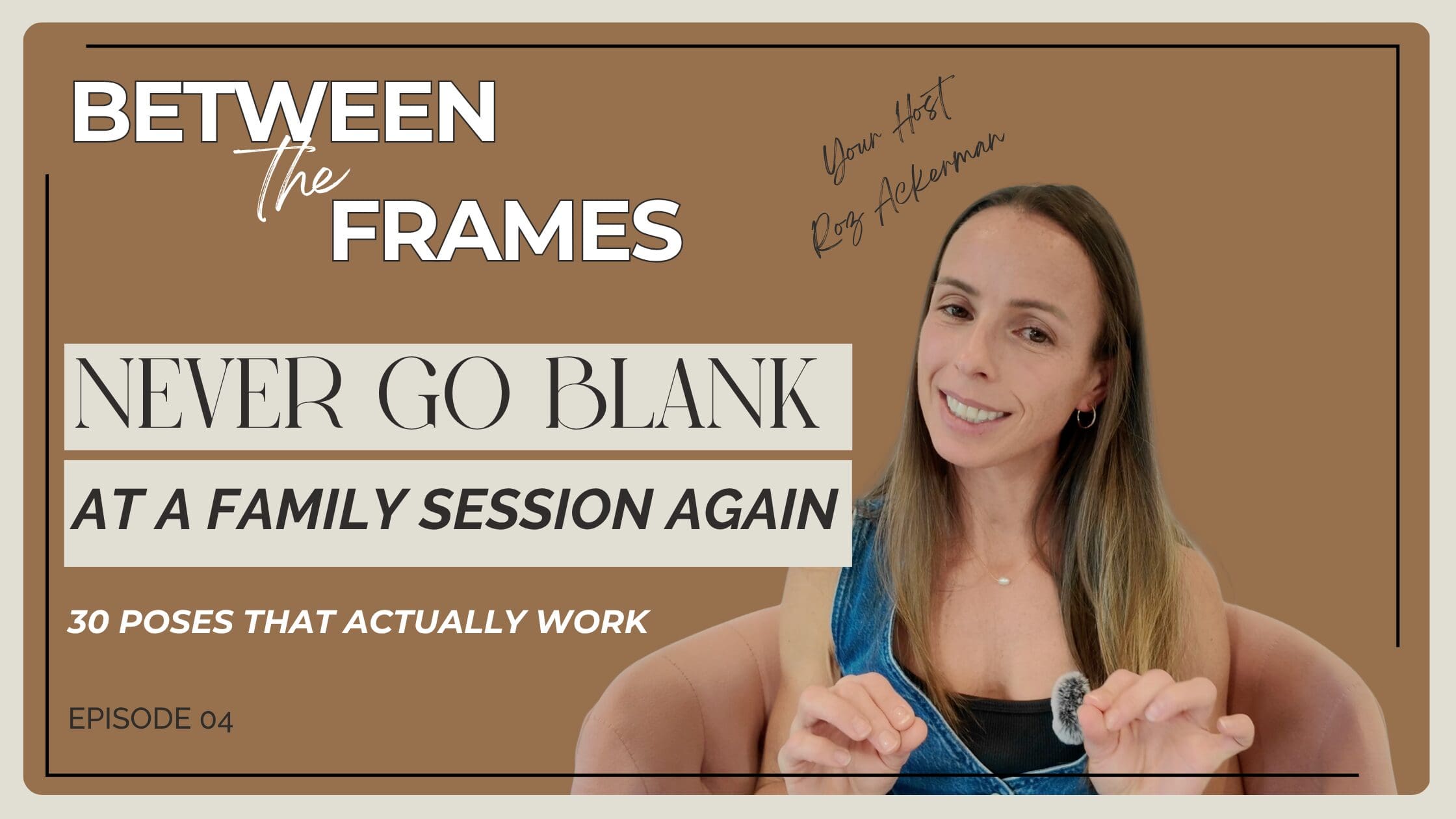
What We Cover in this Episode
This episode picks up right where 𝙎𝙩𝙤𝙥 𝙋𝙤𝙨𝙞𝙣𝙜, 𝙎𝙩𝙖𝙧𝙩 𝙋𝙧𝙤𝙢𝙥𝙩𝙞𝙣𝙜 (𝙀𝙥𝙞𝙨𝙤𝙙𝙚 3) left off. If that episode was about finding the right words, this one hands you the visual playbook to go with them — 30 poses, broken into three categories, with the real prompts and small details Roz watches for in each one.
CONNECTION POSES | POSES 1-12
Connection poses open the list, and they’re the emotional backbone of the episode. These are the quieter, slower moments — peekaboo, nose boops, whispered secrets, the surprise blanket hug — that don’t look like much in the moment but end up being the images families can’t stop looking at. I walk through twelve of these poses, including a few favorites like the “does baby’s hair smell like strawberries” prompt for newborn sessions and the cloud-watching pose I come back to again and again.
MOVEMENT POSES | POSES 13-19
Movement poses pick up the pace. This is where I get families walking, running, climbing, and carrying each other — the kind of authentic motion that makes a gallery feel alive instead of staged. I talk through my favorite “lead your parent” walking prompt, the logistics of the blanket run, and why I’m always trying to weave in a few traditional smiling-at-camera portraits even in a lifestyle-heavy session.
PLAYFUL POSES | POSES 20-31
Playful poses close out the list at peak energy — flying, spinning, tag, the blanket swing, and the rocket-ship launch that’s become one of my session staples. These are the poses that don’t always make the wall print, but they’re the ones that get shared, laughed over, and remembered.
I wrap up the episode by explaining how I actually move through these categories in a real session — reading the family as they arrive, starting low and slow, building energy in waves rather than all at once, and winding back down for golden hour. It’s less of a checklist and more of a rhythm I’ve internalized over hundreds of sessions.
KEY TAKEAWAYS
Posing is the vision, prompting is how you get there. The two work together rather than against each other — this episode gives you the mental library of what to aim for, while the prompts from Episode 3 give you the language to actually get your families there.
Name your poses. Just like prompts, poses are far easier to remember once you’ve given them a label. “Rocket ship,” “blanket hug,” “row your boat” — once it has a name, it’s instantly easier to recall mid-session instead of fumbling for what to do next.
When something looks off, close the gaps. If a pose isn’t landing the way you pictured it, check for distance between family members — usually dad. Tightening everyone in physically almost always fixes the awkwardness.
Think in waves, not straight lines. Energy should build, peak, and come back down over the course of a session. Running through every playful pose back to back will leave kids wound up and hard to settle — pace yourself the way you’d pace a story.
The blanket is basically its own category. Bring one to every session. Between cloud watching, the surprise hug, the drag, and the swing, a single blanket unlocks a huge chunk of this list.
Kids cooperate more when they feel like they’re leading. Giving a child a task — “lead daddy to that big rock” — gets a far more natural result than asking them to simply pose. It’s a small shift that changes the whole tone of a session.
Episode Transcript
30 Poses That Actually Work at Family Photo Sessions
0:01 If you’ve ever stood in front of a family at a photo session and gone completely blank, then this episode is for you. So welcome back to another episode of Between the Frames. I’m your host, Roz Ackerman, and this is going to be a full episode, you guys — I have so much information I want to share with you. But as promised, I want to dive in and give you the bare bones of what to expect for this episode.
This episode is coming after the one all about prompts. So if you haven’t listened to that episode yet, it’s called Stop Posing, Start Prompting — I encourage you to go listen to that one first. You may be a little confused as to why I’m now doing a follow-up episode that’s talking specifically about posing. Yes, I guess the title of my last episode was just a little bit hooky, so to speak, because “not to pose at all” isn’t really what I was saying. What I was trying to encourage you guys to do there is think about prompting more than posing.
But today I do actually want to provide you with a lot — I’ve got 30 poses here, you guys. A lot of poses that will give you ideas so that when you’re looking at a family, you can picture something in your head of what you’re looking to achieve, and then you can really use those prompts to help get your families into exactly what it is that you’re envisioning.
I’ve organized these 30 poses into categories that kind of make sense for my brain — I hope they make sense for yours too. And I will say, this is not really a checklist. This is not the be-all and end-all, but this is a lot of poses, and they are ones that consistently do well. They are tried and true, tested — they work.
2:11 Alright, you guys, before we dive into my long list of poses, I do want to give you a quick little life update. So I think when I was recording my last episode all about prompts, it was just before the weekend — it was my husband’s birthday, I had two other kid birthday parties lined up, one of them was my son’s, and then we had one of his friend’s birthdays on the Sunday. Oh my goodness, I just felt completely nonhuman on Monday. Even on Sunday, I just struggled to do anything. The birthday party was in the morning and it was so hot outside — although their backyard was shady, we were just outside melting all morning.
So yeah, I just needed to cool off. I took a shower and was like, you know what, I actually need to go take a nap. I took a nap when my son was napping — he’s not really napping anymore, but he took some quiet time — and I still felt horrible when I woke up. Yesterday I woke up again kind of on the struggle bus. But I tell you what, I say this to my members at the gym where I coach all the time: you are one workout away from feeling infinitely better. And it’s so true. I did not want to work out yesterday, and I worked out, and I felt so much better. Today too — my son was up in the night, he woke me up early, so I probably got like 6 hours of sleep, and I’m actually feeling okay. I’m kind of surprised.
So highly recommend it — if you’re not currently working out or adding a little workout time into your day-to-day life, I encourage you to do that. Anyway, I survived all the birthday stuff, but yesterday was kind of a shocker of a day because I usually love Mondays — my kids are back in school and I feel like I have so much time to get on top of everything — and yeah, it just did not happen. I feel like it was an unproductive day.
I had a client reach out, and I’m not complaining at all, but their session is in like a month and a little over, and it’s an extended family session, so there’s a lot of coordination going on, especially when it comes to outfits, and they’re traveling. They wanted to get on top of the whole outfit thing, which I completely understand — they were already on my to-do list to reach out to. But anyway, she reached out sounding a little desperate, so I was like, okay, I’m going to curate this little style guide booklet for them, because I also have this vision about doing a cute picnic for them since there’s going to be so many of them. So she wanted to understand what that vision looked like.
Anyway, I created this whole deck in Canva and it looked amazing and I sent that out, but it took me a while to do that, and then I got a couple of inquiries in, so I had to respond to those really quickly, and I don’t know — the entire day just disappeared, and then I had to go coach. So yeah, did not get any editing done as planned. But I feel like that is really common when you’re an entrepreneur — there are going to be plenty of days when you feel like you’re not being productive, or you weren’t productive in the way you wanted to be, and it just feels like you’re not moving forward and like everything is just adding, adding, adding.
So I’ll just say, it happens to all of us. It happens to the best of us. You will get that time to catch up, but really, the work is always going to be there, which is a good thing — we want to have work. So just try not to let it spiral in your mind and develop into anxiety. I’m saying this as much for myself as I am for you guys. Anyway, if you had an unproductive day, today’s a new day — get into your editing, get some of that done.
What else is going on in my life? I have a little bit of a mystery happening with my car key. We have a Honda Pilot, and I changed the battery for it at least a month ago, and it’s been working absolutely fine, but all of a sudden recently, whenever I try to start the car and the key is in the car, it just won’t start — it’s saying it can’t detect where the key is. It’s really strange. I think it was yesterday — yeah, it was literally yesterday — I turned the car off, locked it, unlocked it, pressed the brake pedal, tried to push the start button, and nothing was happening. It’s so weird.
Anyway, I Googled it later, and apparently if you have an AirTag, that can really interfere with your car key’s ability to function. So I took that out and the car seemed to be working — I was like, oh my gosh, mystery solved, great. But then my car did the same thing again this morning. So I don’t know if any of you guys have any insights — I would love the tips, give me the advice. Maybe I need to change the battery again. I don’t know. Anyway, sorry to put this on you, but I need some help in my life. Adulting is hard.
Alright, I’m just going to wrap things up real quick. I do have quite a lot of things I’m looking forward to this summer, because it’s already so hot outside — it’s only the second week of June and I feel like the climate is getting hotter every year. So it’s definitely summer, and I started thinking about all the things I have lined up. I’m super excited — this weekend I’m actually shooting an elopement in Buena Vista. So that’s really fun, I’m excited. And then my extended family session is also coming up in Winter Park, so again, I’m just loving sessions in the mountains, I cannot wait. If you know anybody wanting sessions in the mountains and it’s not your jam, hit me up — I love that stuff.
I’m also going to be taking a little personal trip — it’s a photography workshop and kind of a retreat in Crested Butte, so that’s in July. I cannot wait to see the wildflowers there. I really hope nothing weird is going on because of the weather being so hot and that we don’t miss them. Fingers crossed we don’t — I’d love to see those wildflowers.
9:25 Okay, without further ado, I am going to get into all the stuff you are here for. Since in my last episode, when I was talking about prompting, I was kind of saying “stop posing” — you may be asking the question, well, why pose at all?
Well first off, I do think it’s important to highlight that distinction between posing and prompting. When you’re prompting, you’re directing, you’re guiding, and you’re not really organizing people’s bodies, so to speak — you’re delivering a concept or an idea and then taking a step back and watching to see what unfolds. With posing, you’re being a lot more deliberate. You’re thinking about hand placement. I think it comes a lot more naturally with couples sessions because there are only two people — posing is just a lot easier than family sessions when there are a lot of people. You’re being really intentional with where bodies are in relation to each other, where that hand placement is, where people’s eyes are looking, all of that stuff.
So that’s the difference between the two. Prompting is about how you’re talking and what you’re saying. Posing is the vision, the idea of what you’re building toward. Usually I like to have my list of go-to prompts that I know I’m going to use, but I also like to have a little checklist in my head of poses that I think are going to work really well for that particular session. And obviously I do have my go-tos — if you use them time and time again, they become more natural, you don’t even have to think about them, you naturally know where you’re going. So it’s great to have some go-tos.
I feel like remembering the poses can be hard. I think with prompts you can kind of name them, and I would encourage you to do the same with poses. If you name something — let’s just say “rocket ship” — and you know that’s the one where dad is pulling the kid up in front of him, anytime you label something, it’s going to be infinitely easier for your brain to remember it. I like to have my little checklist in my head of poses that I’m thinking are going to work well for that session.
Speaking directly to posing, I find if I’m struggling with not understanding why a pose isn’t working, I think a lot of the time it’s because the connection isn’t there. Maybe you prompted a family to do something — maybe they’re walking together hand in hand, or maybe you prompted mom and dad to hug, or maybe it’s a group family hug, everybody hug in together — and sometimes it can still look a little awkward, something might be off. So something I like to remind myself of is this little phrase: close the gaps. It’s really simple, very memorable. What you’re essentially saying to yourself is, okay, are there any gaps, is anything looking off? And I will say, usually this is dad — so you’re going to want to look at dad — and just tighten everything in. We want that closeness, we want that connection. Obviously there are beautiful opportunities and poses where a little distance or some gaps look great, but you need to be very intentional with that.
13:26 Okay, so as I already mentioned, I’ve categorized these poses, and the first category is connection-based poses. This is just kind of how I like to think of them — these are more slower paced, typically. They’re more the emotional anchors of a session. These are the ones that will fill your gallery with a lot of feeling and emotion. I will say that a lot of the time they’re going to be a lot more candid — it’s going to potentially not look like a lot when you’re shooting them, but then when you get them back and you’re able to crop and apply your edits, they’re going to be the ones that really draw people in.
Alright, so here are my poses, and I’ll embellish as I go along.
Number one — peekaboo. Honestly, there are a lot of variations of peekaboo. You can have parents playing peekaboo with their kids, especially if they have little kids — literally hands over their eyes. But this also works quite well with shy or slightly more timid kids. You can have the kid play peekaboo behind their parents — maybe they’re hugging or holding onto their parent from behind. I’m thinking mom or dad are seated on the ground here, but it could also work standing, like maybe they’re hiding behind their legs. You just kind of encourage the kid to play peekaboo — literally play with the kid, “Oh my gosh, where’d you go? Oh, you’re hiding, I can’t see you… peekaboo!” That’s what I sound like when I talk to my toddler. Instant silliness, gets a lot of genuine smiles. Another variation: you could have the kid on dad’s shoulders and have the kid put their hands over dad’s eyes. Obviously he’s not moving around for this one, that would be a little dangerous, but just encourage the kid to place his hands over dad’s eyes and do peekaboo — that can look really cute too.
Number two — whispering a silly word or favorite color or favorite animal, something like that. Just trying to get the kid to whisper something into their parent’s ear. This also works well with siblings — if you’re trying to get that sibling connection, usually it works best with siblings. You just have one of the kids, probably the older one, encourage them to whisper something silly into their sibling’s ear. I like to also ask favorite animals, and I think it’s fun if you can really get them to think — so sometimes I’ll say, “What’s your favorite animal?” and they’ll tell me, and I’ll say, “Can you tell mom your second favorite animal?” And they have to think about it for a second and whisper into mom’s ear.
Number three — boop somebody’s nose. This works well — you can have the kiddo boop mommy on the nose with their finger, or literally rub noses, that one’s so cute. My son loves to do that. Just a little nose boop can look so cute, and the kids love to do it, sometimes a little too intensely — but usually when you capture it, get all the different angles, and you can’t really tell if they’re being a little too aggressive.
Number four — an extension of that: nose kiss, but you can also do any variation of that — a little kiss on the top of the head, even maybe a butterfly kiss, but just some kind of closer connection.
Number five — tickle. This one’s super easy. Usually best if everyone’s sitting down or even lying down. I quite often bring a blanket to my sessions, so I love to get laying-down poses if possible. A kind of blanket snuggle that turns into a little tickle party or tickle fight is really cute and super easy to remember.
Number six — this one is really good for newborn sessions, but it can work well if you’re trying to get that parent-child closeness and want the child to initiate it. The prompt here is: does baby’s hair smell like strawberries, or maybe ice cream, or something the toddler is interested in? What we’re looking for here is nose in the hair. That one can just look so beautiful — it’s really an extension of the kissing pose, but I like to try to have a toddler, a younger child, do this to a parent. It works beautifully in newborn sessions if you’re trying to capture that closeness between the older sibling and their new baby.
Number seven — as well as using your blanket for laying on the floor, you can use the blanket in a lot of different ways. Actually, if you want to think of the blanket as a prop and a category all on its own, you can have a lot of different options there. This one I have is the surprise blanket hug. I love this if you have siblings together — have them stand close together, hold hands, maybe encourage them to close their eyes or look up at the sky, just distract them. The parents are in the background — even before any of the action happens, mom and dad are in the background holding this blanket. You’re going to focus in on the kids in front, and then maybe even focus in on the background with the parents. Then you’re going to say a magic word that the kids don’t know — you’ve already told the parents — and when you say that magic word, the parents run in and wrap their kids in that blanket in a nice big hug. Honestly, I feel like this one never fails. I always get a great reaction from the kids and the parents too — the parents are really having fun, they’re letting go for a minute, they forget what they’re doing, and they’re just in the moment having fun with their kids. So beautiful for a lot of different reactions, but yeah, everyone looks so happy in that moment. I love it.
Number eight — kids hugging parents from behind. Usually for this, parents are going to be seated, and it’s super easy — you can get a sweet couple moment with mom and dad. You can have them seated kind of shoulder to shoulder, angled in, or hip to hip, if you don’t want them completely front-on to you, and then there’s space behind for the kiddos to give mom and dad a hug. You want to encourage them to be gentle — sometimes they have that tendency to choke mom and dad out a little bit. Just ask them to lean in, and sometimes kids may already be running around, so you say, “Okay, on the count of three, we’re going to run around, and on three, let’s give mom and dad a big hug.” Kids often need that little lead-up to something, and counting to three usually works.
Number nine — secret handshake. This one is fun for slightly older kids — I don’t know if it would really work with toddlers, maybe it will, depends how much of that kind of thing you already do at home — but just ask them to invent a secret handshake with their parent or even with their sibling, on the spot, and see what happens. I think this would work well with the age group of maybe four, but I’m leaning toward five and up.
Number 10 — row your boat. The child is going to be sitting in their parent’s lap facing in, parents have their knees bent, and we’re just going for a little rocking motion here. This is a great way to set up that pose of child in parent’s lap and that closeness, a little playfulness, but also sometimes kids just get really snuggly in this pose. It’s a great opportunity to capture that closeness, that connection.
Number 11 — cloud watching. This is a great one to do laying down on the blanket. Have them positioned close together, maybe heads all toward one top end — you could have one kiddo laying their head where they would naturally, like on their parent’s shoulder or chest — and just ask them to look up, see what clouds there are, can they see any animals, that kind of thing. Encourage the parents to point too. I love those ones, they feel very nostalgic, and they will absolutely be a big hit in your galleries.
Number 12 — this one’s great, you can use a prop. Sometimes if kids are really shy, or if there’s a special prop like a book that parents might want to bring from home, that’s a great way to get that intentional connection and closeness. Just have the kiddo in the parent’s lap and they can read a little book they brought with them. If they didn’t bring a book, I encourage you to find things in nature — pick up a leaf, a flower, and prompt the parent to show it to the kid and look for specific things: what colors do we see, are there any bugs in there, that kind of thing. But basically, you’re trying to capture that interaction with nature, and the closeness there can be so beautiful.
Alright, so that was my category of connection-based poses. There were a couple of playful ones in there, but mostly these are a little more slower paced. Now we’re going to move on to the fun movement poses.
25:48 Okay, so these are a little more action-based — this is where the session tends to feel a little more energetic. I’ll encourage you to read your family, see how they’re feeling — if things are slowing down too much, then maybe you need some of these movement poses to bring the energy back up again, depending on what time it is and where you are in your session. We don’t want the kiddos to start getting tired and bored and being done with the entire session.
Number 13 — walking. I like to really try to empower the kids as much as possible in my sessions — it just helps them feel like they’re a part of it and not being told what to do. Ask the child to lead their dad or mom over to that big rock over there. Maybe you can say, “Oh, I think I saw a rabbit hiding behind that rock — maybe you can lead daddy over there and see if it’s still there.” Something like that. You’ll get a really beautiful situation where you’re having the small child lead their parent — I absolutely love that, it feels very poetic. There’s lots of opportunity to capture some small details with that — you can get the wide angle, the medium shot, and then close-ups with the hand being held, the feet on the path, all that kind of stuff.
Number 14 — running. Stepping up that energy level just a touch more. You can have them run toward you or run away — sometimes kids really want to do this anyway, so they’ll run away from the parents toward me, and then I’ll have them run back to their parents. And if you make it a race — 1, 2, 3, go — they are all in, they love it. If they’re running away from me, parents can catch them, so that one’s great. You can also have the entire family running together, the kids love that — make it a race, “I wonder if you can run faster than mom and dad, let’s see,” or “let’s all hold hands and see if you can make mom and dad run really fast.”
Number 15 — this one is all about getting the kids more to the same height as the parents. Having the kids get a piggyback ride from the parents, or go on their shoulders, or even just carrying them on your hip if they’re on the younger side. All of those variations read very differently, and I love them all. I really love the visual of one kid on dad’s shoulders, dad holding hands with mom, and then another kid on the end of that chain, also holding hands with mom — that’s just such a beautiful line, and visually it looks really appealing. You can also get mom and dad to come in really close and maybe have mom pick up the other child — that one would look great for just a portrait, with a lot of visual height differences in there. It’s going to look very appealing.
Number 16 — dancing. This one’s easy — don’t forget to encourage your clients to dance during a session. You can have them hold hands, or just hold one hand. This goes for mom and dad too — have them twirl. All of those things look so beautiful, I don’t think it needs a lot of explanation. Just don’t overthink it. If for some reason it’s not working out, sometimes I find the twirl can be a little tricky and you can keep missing the face of the person who’s twirling — just make sure they’re holding opposite hands.
Number 17 — an animal-based prompt. This is just going to get some laughs, but it’s also going to help a kid come back into the session if they’re not really cooperating. This didn’t work for my son recently when I was trying to get his attention, but you can encourage them to stomp like a dinosaur, or “hey, can we fly like birds, or like butterflies, or like an airplane?” Essentially what we’re looking for is a movement-based pose where something is happening, there’s action, and it looks playful, it looks fun — mom and dad maybe are participating, or maybe they’re holding hands and watching. That’s kind of what you’re looking for with that particular prompt.
Number 18 — kids like to climb. If you can see anything at your session that’s safe for a kid to climb, I’d encourage you to use it. It’s a great way to get into a more traditional portrait. I will say, as much as my galleries include a lot of lifestyle-based, candid poses, I’m still looking for those opportunities where I can get beautiful portraits with everybody smiling and looking at the camera, because I think it’s important to still include a handful of those in people’s galleries. I think people still want them — I don’t know that they necessarily always use them, but I do think they want them. Climbing really gives you that opportunity, especially if there’s a fence — think about kiddo climbing up the fence and then sitting on it, maybe dad is behind, mom’s in front leaning on the fence. It sets it up well, staggering the height of everybody so you can get that beautiful, clean portrait of everyone smiling at the camera. You can also use a rock or a tree or anything — but obviously, make sure it’s safe. And don’t forget to work your angles — this goes without saying for every single prompt and pose — capture it from different angles so you’re getting that variety in your gallery.
Number 19 — the blanket run. This time, mom and dad hold the blanket — kind of like a matador’s cape — one end each, opposite each other — and they’re going to lift the blanket up and down, and the kids run through or under it. You’re looking for that wide shot where you can see the whole frame and everybody, and then you want to get down low and get that picture of the kids running through the blanket. You’re going to get a lot of laughs, beautiful flowing fabric — it’s stunning. Make sure you’re getting all the angles again with that one.
That was the movement category. Now we’re moving into an even more playful set of poses.
33:27 Okay, so those last ones were pretty energetic, but these ones are going to be even more playful. Again, I think this is just a beautiful grouping to include in your gallery, and it’s going to feel very nostalgic — not just for the parents, but for the kids too. I think that’s something we forget — the images we’re creating now are not just for the parents, they’re for the children too, now but also as they grow up. My kids are obsessed with looking at photos of us and talking about them, and it’s so interesting to me. I don’t know if I was this obsessed with family photos when I was a kid, but my kids really are — we have frames going up our stairwell, and almost every single day my kids will point something out about them to me, to the point that I really need to keep adding more because we’re running out of stuff to say about the ones currently on the wall. There we go, I just added something to my to-do list.
Number 20 — Superman with a parent. The parent is going to be laying on their back, and the child is going to be balancing on their feet or knees, kind of depending on how big the kiddo is. It’s pretty self-explanatory. I mentioned this one at a family session recently and they said, “Oh, we haven’t done this before” — so maybe with smaller kids it’s not something everybody does. We’re very much a floor-based-play family — the kids did gymnastics early on, Jason wrestles — so I feel like it’s pretty straightforward for us.
Number 21 — family pile-on. Usually I’ll have mom and dad lay down, or dad lay down and mom sit up, or parents are just on the ground, and then the kids pile onto them. There’s not necessarily a specific composition here — you’re just looking for that messiness of what happens when everyone piles on dad or piles on mom. There’s usually a lot of laughter, and it’s super fun. I love that one, and I love when it just happens naturally and I don’t even need to prompt the family to do it — I’m just setting the blanket down, we’re going to lay down, and then all of a sudden they’re piling on dad. I’m like, cool, this is great, let’s go with it. If you have a blanket, just watch out — magical things happen.
Number 22 — flying toward the camera. This is a good one, especially if you only have one kid in the session and they’re younger. It does work well with multiple kids too. You can have either one parent or both — let me talk about both variations now. With just one: usually I’ll have dad hold the kiddo under their belly, one arm under the belly, the other on top, and he’s spinning around and flying the kid toward mom. Mom is somewhere there, putting her arms out, making that connection. It’s a beautiful pose eventually after the prompt, because you can have these moments of separation and connection where maybe baby and mom connect hands — it’s really beautiful. I love this one too, not just for that front-on wide angle, but also if I’m laying down on the ground — I’ll often have them do this multiple times, lay down and get that action of baby flying through the air and then reaching for mom’s hands, mom’s hands touching baby’s. It’s so cute, I love it, and you get that blue sky, it’s so pretty.
Number 23 — the second variation: both mom and dad standing side by side, usually with one of them having their arm under the chest or torso area, and the other supporting the thighs, and they’re swinging baby toward me, toward the camera. That one’s beautiful too — I kind of like number one [flying toward one parent] more, but number two is also really great.
Number 24 — spinning. For this one, we’re going to have the child facing out, but they can also face in, whatever — you can do both. Usually we’re grabbing the kiddo underneath their armpits, mom or dad connecting their hands in front of their chest, and they’re just spinning around. Kids love it, parents love it, everyone gets a little dizzy. Honestly, you can move to the blanket on the floor after that one for a bit. Usually the kids want to do this over and over, which is great because you can get some of them facing out, and then some where they’re facing in, or maybe they’ve got their arms wrapped around mom or dad’s neck and they’re spinning that way. Lots of variations of spinning.
Number 25 — play tag. Oh my gosh, such a hit, always a hit. Works well with older kiddos too — if you have siblings, you can have the siblings play tag while mom and dad snuggle and sit and watch and laugh. You can also have the entire family play tag, honestly it’s great, I love it. Just try to keep them in a relative circle, or define the space being used so they don’t completely go off out of your shot. You can rotate through who is going to be “it” — usually the kids always want to be it, but sometimes they like it when dad is it. Just let everyone have a turn, the kids will let you know what they want to do.
Number 26 — ring around the rosie. I like this one — obviously we’re making a circle, everyone connecting their hands. Usually people face in and do ring around the rosie that way, and that’s great — be ready for the moment where they all fall on the floor, get the smiles for that one. I also like to do it where everyone faces out, because that way you get their faces as they’re in the circle, and you usually get a lot of smiles in that one too.
Number 27 — airplanes. This is sort of an extension of tag, similar to the animal prompts earlier. If you’re ever stuck, just think “airplanes” — if you’ve run out of ideas, what haven’t I done? Being airplanes is so fun, I love to do this with couples as well, and I feel like families love it — the kids obviously do, but the grown-ups, the parents, love it too. Just go in a circle, or everyone’s weaving in and out in the same area.
Number 28 — back to the blanket: the blanket drag. This one’s great — I will say you kind of have to be careful where you’re doing it if you care about your blanket and don’t want it to get crazy dirty, or you may want to stack your blanket onto more of a tablecloth that has that wipeable surface area, because you’re going to be dragging the kids on a blanket. I did use a blanket once in a very grassy park area and it got really badly grass-stained — I think it came out, but I just want to point that out. You’ll have one or two kids sit on the blanket toward the front end, and mom and dad are behind with the back end of the blanket, dragging them, giving them a ride. I love to focus in on the kids for this one, with mom and dad sort of more blurry in the background. Naturally the kids end up falling backward onto the blanket, and that’s a great opportunity for everybody to come down and pile on top of each other on the blanket. You’ll find that a lot of these poses are kind of mix and match — you’ll have high-energy or playful ones that develop into slightly slower-paced or connection-based poses. Just go with the flow — that’s kind of what you have to do with a family session.
Number 29 — another blanket favorite: the blanket swing. Works well with one to two kids, maybe a third if they’re very small. Essentially you’re going to get the kids toward the middle of the blanket — they can lie down, but it’s great if you can try to have them sit up, so the parents are going to want to choke up on the blanket in a way that positions the kids so they don’t go completely flat back, because otherwise you’re not really going to see their faces. Mom and dad are basically going to give them a swing in the blanket — it’s so fun, I love it.
Number 30 — rocket ship or blast off. I mentioned this one at the beginning, actually. Dad holds the child’s hands — usually the kid is in front of dad’s legs, crouching down, dad’s holding their hands or wrists, and he’s going to count 3-2-1, blast off, and pull the child up into the air. We’re mostly focusing on the kiddo for this one, but you can also get that wide angle of the action happening. It’s usually a lot of fun, kids love it, and I would position mom and the other sibling, if there’s another sibling, just off to the side, watching the action happening.
And finally, a bonus pose — the dad toss. I think it’s pretty common — whenever there’s a dad in a session, it’s pretty normal for the kid to get thrown in the air if there’s a younger kid. Dads love to toss their kids in the air. I will say, kids don’t always love it, but you can’t always tell that — so it’s worth a try. Just check with the parents, make sure they’re okay with it. Ask dad, “Hey, is this something you do at home?” A lot of the time they’ll say yeah, all the time, they love it, let’s do it. So I’ll say it’s definitely a favorite and gets used pretty often. Just like that last pose, this is one mom and the other sibling can watch — maybe seated on the ground, maybe standing. I love to get that difference in height, so if you can have them seated, it’s great.
47:43 So to wrap everything up, let’s tie a bow on this episode and the last one. Obviously, I’m not going into my sessions with 30 poses and trying to run through the list like a shot list, okay — like, yes, I will have this saved on a note somewhere, but there’s kind of a rough arc that I’ll have in my head, and I’m happy to share that with you.
First off, I’ll definitely just read the family to see how they are as they arrive. Sometimes I’ll say the beginning is actually a great opportunity to get those close, smiley pictures — I feel like kids have often been coached by their parents, or they’re well-prepped, and they have it forefront in their minds that they’re going to get candy or something right after they do the smiley pictures. So oftentimes I think it also takes the pressure off the parents too — if you can try to get that shot done right away, great, because then the parents are immediately relaxed, like, “Oh, they got that photo done, it’s great, wonderful, let’s move on and just have fun with our kids.” So that can be a really great opportunity for that more grounded, connection-based pose where everyone’s looking at the camera and smiling. That’s something I look for in the beginning, and obviously it kind of matches well with that connection-based theme.
Sometimes you might want to start close to the ground — maybe we lay out the blanket to start, or if there are some rocks nearby or a tree trunk, great, let’s sit on the tree trunk and snuggle up close together. I try not to spend too long in that slower pace in the beginning — I like to think of it more as a settling-in period before I get into some movement, because then I feel like the movement-based poses are an opportunity for any awkwardness or anxieties to just kind of be shook out, and we start to move into a more natural rhythm in our session, more natural connection and interactions happening.
With movement, obviously the more playful ones I’ll weave in here and there — I feel like you can’t just go boom, boom, boom with all the playful ones, that’s just going to be too high energy, it’s going to be hard for the kids to come down. So think of it like a wave, if you will — that’s what helps me. You’ll notice when the kids go from having fun to, oh my goodness, they’re starting to be hysterical and slightly crazy and out of control — watch for that, try to think of a wave in terms of the flow of your poses and how much energy is involved in each one.
So usually I like to end with the slightly slower, more connected poses, especially if we’re getting more to that glowy golden hour light — that’s a perfect time to wind things down, be on the blanket, do all the snuggles.
Some of the poses I find myself using a lot — I think I already touched on this as we were talking through them, but I do love the ones on the blanket: laying down looking at clouds, the blanket hug, the surprise blanket hug one is a favorite. The Superman one with dad spinning the child and mom reaching out for the child — and you can flip that too, have mom holding the child and do it the other way around — those ones are beautiful, I love those. I love when the kiddo is leading a parent somewhere, I think those are beautiful too. Oh gosh, there’s so many — what else am I looking for? Booping noses, or getting that nose-to-nose rub, is so cute as well. I love when siblings do the whispering. And then usually, if there’s a daughter, I’m usually looking for something kind of beautiful between mom and daughter — a twirl, a spin, something really beautiful between the two of them. I actually love it if the little girl can put her hands on mom’s cheeks — not to squish, but maybe you can go for that as a prompt, like, “let’s squish mom’s cheeks,” and then let go and play between that and see what happens. But when kids hold their parents’ cheeks in their hands, it’s so cute, I love that so much. So yeah, those are some of my favorites.
And I think as you can kind of tell from this episode, posing and prompting really go hand in hand. For family sessions, I’ll say that posing is more about visualizing the end result, but I wouldn’t necessarily say you’re always being really precise and rigid with how that end pose is going to look. I think if you’re creating the right natural environment, you’re going to get good hand placement, you’re going to get the right kind of eye contact — you’re going to get everything from directing your families with all the prompts I just gave you. So yeah, I gave you a lot of prompts, but with the goal that we are creating a specific look, a specific result — we’re looking for something. So there you go, they really go together hand in hand.
I hope this episode has been really helpful for you, and if you think it was, maybe you can share it with another photographer who you think could benefit from this one. I would also love to hear from you if you have some go-to poses that you always use in your family sessions and they work like a charm — maybe I didn’t include them here, I would love to know, please share them with me.
Other than that, I think that’s all I’ve got for you today. I had to stop this podcast a couple of times, so I have no idea how long this episode went for, but hopefully it was just the right amount of time for you. Please, please, please, if you enjoyed this episode, rate, review, subscribe, and I’ll see you next time on Between the Frames.
Leave a Reply Cancel reply
Honest, heartfelt portrait and elopement photographer for modern women and the families they center. Serving Denver, Boulder, Arvada, Lafayette, Louisville, Superior, Westminster and the Colorado Front Range. Available worldwide to tell your story.
ROZ ACKERMAN


©2026 | ROZ ACKERMAN photography
©2026 | ROZ ACKERMAN photography